

Data was collected from 80 multiple lambs born between 28 February – 8 March 2024. This included birth weight, litter size, stomach fill and ewe factors including body condition, milk supply and ease of stripping.
A blood sample was collected from each lamb from 24-48 hours after birth by the farm’s Vet which was then spun down, and serum was tested for the total protein levels as an indirect measure of antibody (IgG) levels in the blood. Bloods were tested using two refractometer methods – Total Protein and Brix refractometers. Unfortunately, due to processing issues 5 bloods did not get run using the Brix refractometer and so 75 results are available for analysis, Figure 1. Lambs were marked with individual numbered management tags to allow accurate data recording.
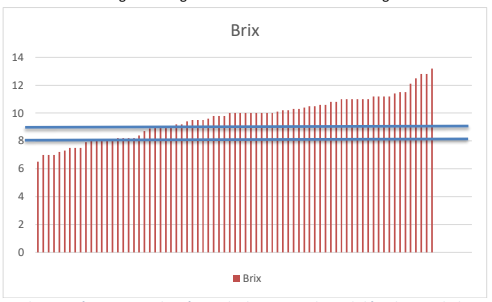
Figure 1: Brix refractometer readings from 75 lamb serum samples graded from lowest to highest
Cut offs for failure of passive transfer were taken as 8%, based on figures from Hamer et al., 2023 Passive Transfer on Brix Scale, with 8-9% intermediate and >9% a good level.
Using these levels 13.3% of lambs had overt failure of passive transfer and therefore did not receive sufficient colostrum, and a further 21.3% were borderline.
Lambs were weighed at 8-weeks-old, which enabled calculation of daily live weight gain (DLWG) up to this point.
The findings thus far are summarised in Table 1.
Table 1: Summary of outcomes measured in relation to passive transfer status
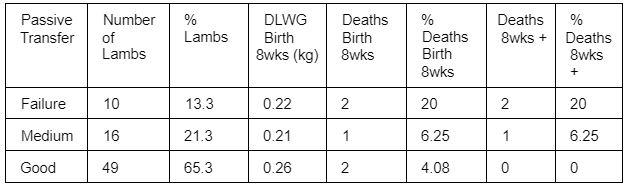
Overall, 10.5% of the project lambs have died to date, but the risk of dying appears much higher for lambs which had inadequate colostrum intakes. This effect seems to last past the first few weeks of life.
Up to 8 weeks old passive transfer status appears to have a limited effect on DLWG, although statistical analysis will allow quantification of this effect. Further figures of DLWG up to finishing will be calculated as lambs are sold and finishing weights and dates become available. Three lambs have been sold to date at 42-44kg live weight.
References
Hamer, K. et al. (2023) ‘Defining optimal thresholds for digital Brix refractometry to determine IgG concentration in ewe colostrum and lamb serum in Scottish lowland sheep flocks’, Preventive Veterinary Medicine, 218, p. 105988. Available at: https://doi.org/10.1016/J.PREVETMED.2023.105988.
This file may not be fully accessible.