

29 April 2026
Operating a profitable farm doesn’t require a vast amount of land, as one successful horticulture business is proving on just 12 acres in rural Pembrokeshire.
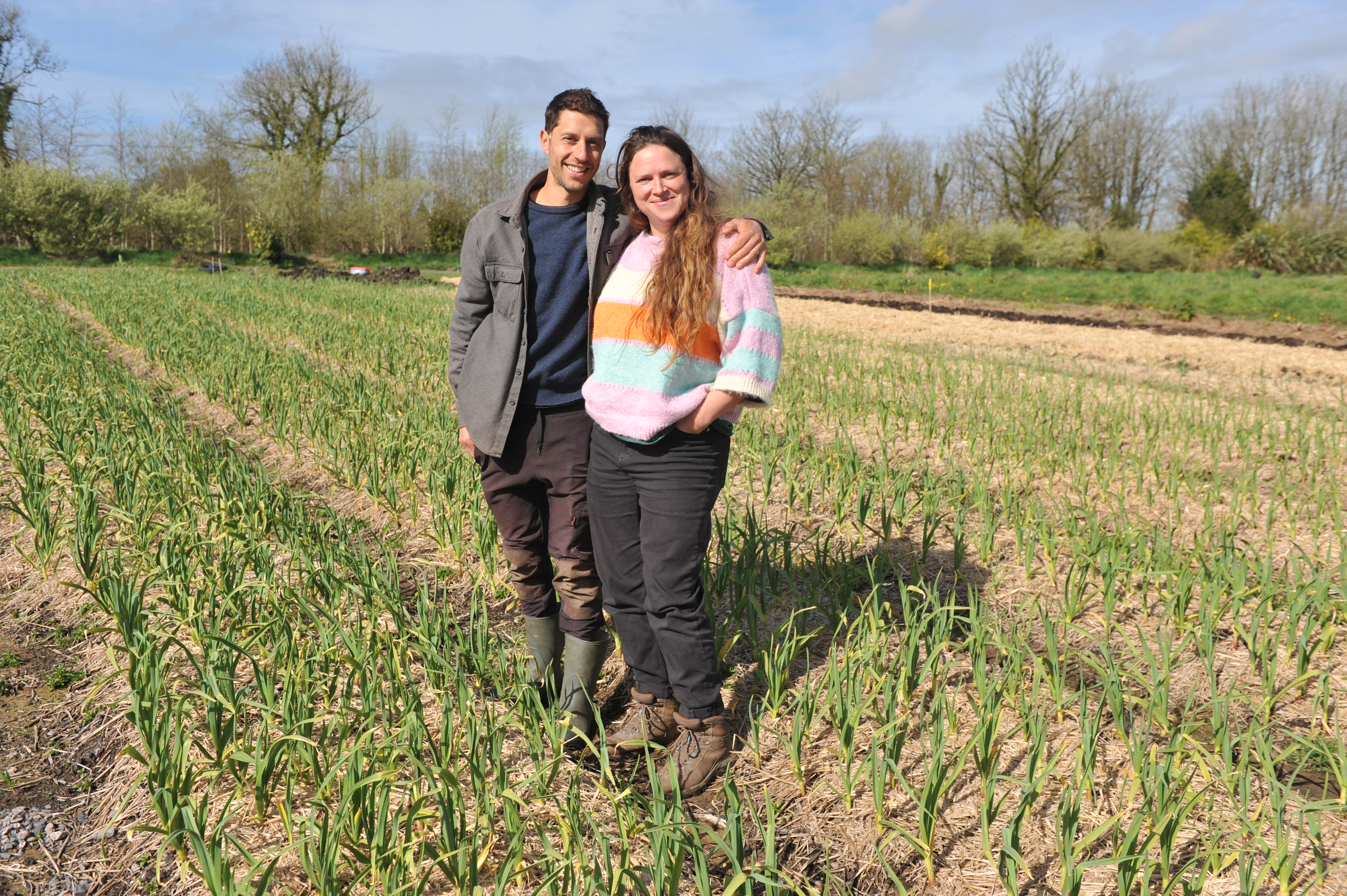
Lauren Simpson and Phil Moore grow seasonal crops for niche markets, demonstrating that farming on a small-scale, utilising far less land than the typical acreage of a family farm, is possible if farmers are creative with the crops they grow.
They had careers as London-based documentary makers before upping sticks in 2017 to farm at Parc y Dderwen, Llangolman.
Neither had a background in agriculture but in the eight years since relocating they have established a successful off-grid farm and associated food business.
The change of direction was prompted by a keen interest in the multiple issues that intersect around food production - land use, climate change, nutrition, workers’ rights and more.
Lauren and Phil specialise in producing naturally fermented and raw sauerkrauts and kimchi, made using ingredients predominantly grown in their market garden.
Seed crops are also grown for Real Seeds and the Wales Seed Hub and garlic plaits are sold wholesale.
They knew there was more they could do to maximise the potential of their land though and in 2025, supported by Farming Connect under its ‘Our Farms’ programme, they embarked on a trial to investigate how perennial culinary, medicinal and soft fruit crops might deliver that ambition.
While sauerkraut and kimchi are Lauren and Phil’s main venture, trialling other crops and exploring the markets for these offered opportunities to increase profitability, a trial overseen by Hannah Norman from Farming Connect.
A 14m x 14m plot was earmarked for the trial; this was covered by an artificial layer for a year to prepare the ground for planting and when removed, manure was spread on top of the soil, and the land cultivated with a single pass of a power harrow and a bed former.
To provide good drainage for the beds earmarked for growing Mediterranean-type herbs and lavender, sand was added to the soil.
A weed suppressing membrane was placed around the plot’s perimeter and in specific beds, to suppress grasses, creeping buttercup and other weeds from encroaching.
It was weeds that proved to be Lauren and Phil’s biggest challenge. They utilised a ground cover of low growing wildflowers as part of their management system, including alpine strawberries, speedwell and ground ivy.
Manual weeding was needed in 2025 and 2026 but once the plants and ground cover have established, control is likely to be much easier, although never completely solved perhaps.
“We have resigned ourselves to acknowledging that we might have to accept a new standard of what is adequate. We might never fully get on top of the weed grass, but the ground cover is definitely helping,’’ says Lauren.
Soft fruit bushes, including blackcurrants, blueberries and redcurrants, were included in the planting scheme, and establishment was good with some fruit produced in the initial season.
With those bushes now in their second year of growth, an increased harvest is expected this season.
The culinary and medicinal herbs also grew well - bergamot, camomile, skullcap and lavender particularly so.
Flowers were the one crop type that didn’t thrive - the aquilega, lupin, sweet William, and yarrow were out-performed by weeds, possibly because they were planted later than the ideal therefore planting will be earlier in 2026.
The support from Farming Connect to run the trial was pivotal, providing Lauren and Phil with the time and resources to experiment with different plants.
“Without that support we just wouldn’t have been able to explore the potential for perennials because trialling different crops is a long game,’’ Lauren admits.
“It could be two or three years before these are profitable but, in the meantime, we have been able to see what works, and what doesn’t.’’
What they have established is that perennial fruit and herb crops are indeed a viable option for existing and new horticulture enterprises.
They also discovered that ground preparation and weed management are key to successful establishment and, with the right management, wildflowers can be a good form of weed control in perennial beds, increasing biodiversity too.
Lauren and Phil received mentoring through Farming Connect from agroforestry specialist Tom Clare, who supported them to integrate native copses, hedgerows and wildflowers for pest management, improve reedbed plant diversity, and refine the management of perennial trials to support soil health.
Some of the crops grown were profitable in the first season - the entire crop of skullcap was sold to herbal products company Avicena, which produces essential oils, beauty products and ointments.
Lauren and Phil also have a jam and chutney maker lined up to buy soft fruit in the future.
They too are using some of the herbs in their own fermented foods business, and the floral crops for seed production are sold via the Wales Seed Hub.
The acreage at Parc y Dderwen is micro compared to the average farm, and the work can be labour intensive, but Lauren and Phil have no regrets about stepping away from their old life.
“It was a bit of a sliding doors moment, but I honestly can’t imagine going back to our old life now,’’ says Lauren.
Farming Connect is currently recruiting for the next cohort of demonstration farms to join the Our Farms network. Expressions of interest must be submitted by 10am, Monday 18 May 2026.
Farmers registered with Farming Connect can access up to 15 hours of fully funded mentoring sessions with any of their mentors. Further details are available on the Farming Connect website.