- Status:
- Complete
- Farmed by:
- Chris & Glyn Davies
- Location:
- Awel y Grug, Welshpool
- Sector:
- Beef, Sheep
Overview
Having been part of various Farming Connect discussion groups since 2018, Chris has embraced opportunities to learn and share ideas with other farmers and industry experts which has translated to several adaptations to the sheep system at Awel y Grug.
Following a discussion group meeting with guest speaker Eurion Thomas from Techion, the group considered their own internal parasite management strategy, and with further discussions with Independent Sheep Consultant Kate Phillips, it encouraged Chris to work with his vet (Hafren Vets) to review their anthelmintic usage.
A faecal egg count (FEC) reduction test or efficacy test of the White Drench (1-BZ) revealed worm resistance to that anthelmintic group, which could have developed due to over-reliance on that single drench group. The advice from Hafren Vets was to only use the White drench to treat against Nematodirus, when Strongyle worm burdens are low and to then rotate the yellow (2-LV) and clear (3-ML) drenches for the rest of the season (orange (4-AD) and purple (5-SI) being used at strategic times, with the aim of avoiding developing resistance towards those drench groups.
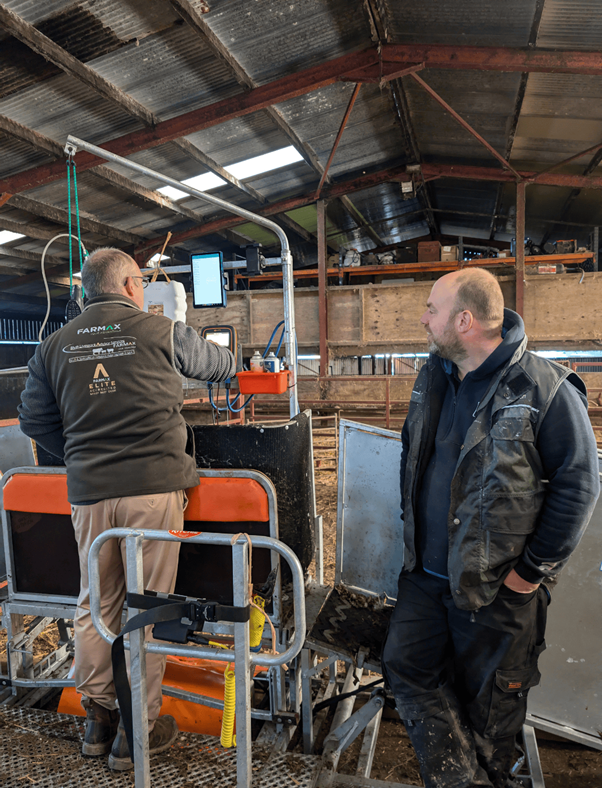
In order to further protect the efficacy of available anthelmintics, Chris and Glyn at Awel y Grug have invested in technology in the form of an auto calibrated dosing applicator that will connect to the farm’s lamb weigher and adjust the dose according to the lamb’s weight, ensuring the correct dose is administered to each lamb.
To complement the technology purchased by the farm, this project will seek to demonstrate how a targeted selective treatment (TST) strategy can be used to protect drench efficacy while ensuring a minimum drop-off in performance. We will also aim to calculate the monetary saving by using a combination of the auto drencher and TST strategy compared to the usual strategy of drenching whole mobs of lambs based on pool FEC sampling results.
The project will contribute to the Sustainable Land Management outcomes including:
- High animal health and welfare
- resource efficiency
Latest Project Timeline
September 2025
What has been done?
Targeted Selective Treatment (TST) is well underway at Awel y Grug and has already shown positive outcomes. We initially started with a FEC reduction test to identify the efficacy of anthelmintics within the flock. A resistance to the white drench (1-BZ) was found, and so can only be used moving forward to control Nematodirus when strongyle worm burdens are low.
In just two treatment cycles, one in June and one in July, 855 fewer doses were administered to the lambs, resulting in a saving of nearly £60 in drench costs and dosing time cut dramatically. A recent session took only 30 minutes—three times faster than treating the whole group, and importantly, worms are not building resistance due to unnecessary dosing.
Fiona Kenyon, Principal Research Scientist at the Moredun Research Institute, analysed the FEC samples to establish which worm species were present. This helped to understand which worm species were developing wormer resistance and allows optimisation when specific drug classes are most effective.
What's next?
Moving forward, the TST programme will continue at Awel y Grug and FEC monitored through into the autumn.