

Group Background
The farmers in the group are part of two core Farming Connect discussion groups, one based around Welshpool and one in the South East. One farmer joined from the South West. The aim of the project was to use data to discover the mastitis pattern on these farms, and to then deliver expert advice (from vet James Breen) on how to reduce the incidence of clinical and sub-clinical mastitis. Anna Bowen from Anderson Centre was responsible in the coordination of this project.
What is a mastitis pattern tool?
The mastitis pattern tool was developed by ǪMMS and AHDB and analyses milk recording and clinical mastitis data to predict the pattern of mastitis infection on farm. There are two types of mastitis infection, which are then split into lactation or dry period origin.
Environmental mastitis is an infection that has originated in the cow’s environment.
Contagious mastitis is an infection that has been transmitted from cow to cow.
The mastitis pattern tool uses the number of clinical cases and the timing compared to calving date to identify the pattern, coupled with changes in somatic cell count, and seasonal patterns in clinical and sub-clinical cases.
Where a cow has a clinical case of mastitis in the first thirty days of lactation the disease is thought to have originated in the dry period and therefore is classed as dry period origin. Where mastitis occurs more than 30 days in to lactation the infection is lactation origin. With this information advice for reducing mastitis incidence can be tailored to the dry period or lactation. This avoids making changes that will have no impact e.g. altering pre-milking teat preparation in a herd with a dry period pattern.
By today only around 8% of mastitis patterns are believed to be contagious, due in part to the success of historic campaigns that focused on improving post-milking teat disinfection. None of the farms in this project showed a contagious mastitis pattern at any point of data analysis.
Methodology
All farmers in the group were asked to supply James Breen with somatic cell count and clinical mastitis data. These varied in quality and source depending on how often the farms milk record, whether clinical mastitis data was reported to the milk recorder (or had to be obtained through separate data collection), whether all clinical cases were recorded, and the accuracy of recording individual cow IDs and having them match the milk recorder’s dataset.
Using this information James ran a mastitis pattern tool for each farmer, which showed the predominant mastitis pattern in the last quarter, and current, quarterly, and rolling 12-month incidence rates for clinical mastitis. Further information on cure rates, dry period new infection rates, and incidence rates in heifers could also be calculated where the data supported it.
The reports were re-run half way through the project, again in the autumn of 2024, and are now being run for the final time in early January 2025.
Results
Mastitis Pattern
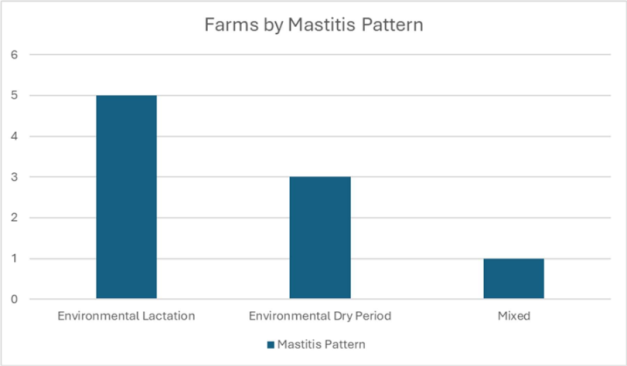
Of the data submitted no farm showed a contagious pattern. All patterns were environmental with a mixture of dry period and lactation origins. One farm showed a mixed pattern.
Clinical Mastitis
Clinical Cases
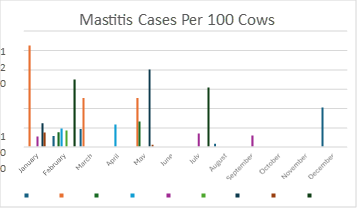
Clinical mastitis cases were collected either as data entered directly to the milk recording company or added to the tool via other software e.g. files transferred from Uniform. James offered instructions on what level of clinical disease was appropriate to record. Information was reported back as monthly data, and rolling data for the quarter and the year. The following table shows monthly data as per the months of analysis. There are gaps where data was not provided.
Sub-Clinical Mastitis
Sub-clinical mastitis data was collected as somatic cell count data from milk recording files. The usefulness of this data is determined by the frequency of milk recording e.g. recording at times to capture cows before and after the dry period and accuracy of cow IDs. SCC is considered high when it is over 200.
Percentage of Herd with High Somatic Cell Count
The percentage of the herd with a SCC exceeding 200 (e.g. classed as having a sub-clinical mastitis infection) was recorded and is presented in the next table as a starting value for each farm.
The initial rate of sub-clinical mastitis (as determined by prevalence of high SCC cows) ranged from 5.5% on Farm I to 21.5% on Farm B. This is particularly interesting when the clinical cases of mastitis are looked at, as Farm I has one of the highest rates of clinical mastitis.
On most of the farms the sub-clinical mastitis prevalence remained similar, with Farm H for example moving from 11.2% to 11.3%. However, a few farms did see significant changes; Farm G increased from 13.3% to 23.4% from the start of the year to May, and Farm D increased from 11.2% to 21.2%. Farm G was the smallest herd and so a change in one cow could be a big jump in percentage.
Dry Period Cure Rate
Dry period cure rate is the percentage of cows that are dried off with a somatic cell count above 200 who calve in under 200; this is an indication that the dry period has succeeded in curing any sub-clinical infections present at dry off. The target dry period cure rate is over 85%.
At the initial data collection five of the nine farms recording were in excess of 85%; Farms G, D, and I were at 100% (care needs to be taken with these numbers when there are small number of cows involved). The lowest rate was Farm C at 33.3% (may be because of a lack of recording data) and Farm E was close to the target at 83.3%. Farm B saw an improvement with their cure rate reaching 85%. Farm H increased from 85.7% to 100%. Farm E had a small reduction to 80%. Farm I had a reduction of 0% but this is likely due to little or no data.
The dry period is the best opportunity to cure sub-clinical infections picked up during lactation, and the best approach to drying off cows as well as selection for dry cow therapy. Using antibiotics in low SCC cows can increase their risk of mastitis, and so blanket treatment should not be used.
Bacteriology
Textbox 144, TextboxA total of 53 individual milk samples were submitted and included in this report. The chart shows the number of samples that yielded each type of pathogen. There is a total of more pathogens than samples because some samples grew multiple organisms.
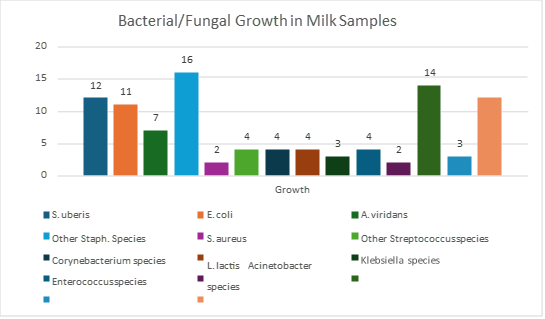
The most commonly isolated single species was S.uberis, followed by E. coli. This is in keeping with published research on bacteriology samples. Seven milk samples grew Aerococcus viridans. This is a Gram-positive bacterium of increasing importance as a mastitis pathogen.
Two samples contained S.aureus but 16 grew other Staphylococcus species.
Knowing the mastitis causing pathogens on farm can ensure that appropriate treatments are used. Where relevant samples were also checked for penicillin sensitivity. Using effective antibiotics is key to ensuring that we as an industry do not contribute to antimicrobial resistance.
Rolling 12- Month Clinical Mastitis Cases
The following graph shows the rolling 12-month mastitis incidence (cases per 100 cows) for the farms at the start and end of the project. The nature of this data means that some farms have seen a rise in incidence, which we would hope to see decrease through 2025 if the farms follow the advice provided by James Breen.
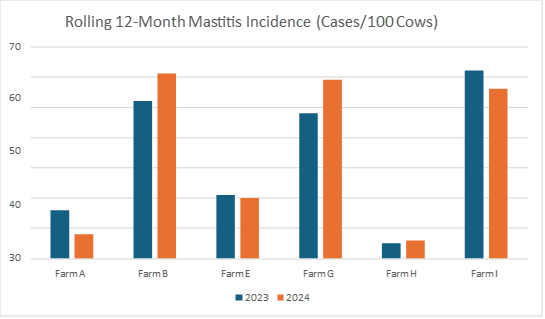
Farm A had a reduction in incidence from 16 cases per 100 cows to 8 cases per 100 cows. Based on the herd size of 231 cows this means a reduction in actual cases from 37 to 19 which at a cost of £314 per clinical case of mastitis is a saving of £5,652 per year. For Farm E there was a very small decrease but as the herd is large the saving is £2,512 per year. For Farm I the saving is £4,082. As per the main report some of the other farms have seen big reductions on a month per month basis and so the change going forward should be a reduction in rolling cases.
Rolling 12- Month Somatic Cell Count
Some of the farms had a problem with SCC rather than clinical cases. The following graph shows the change in rolling SCCs.
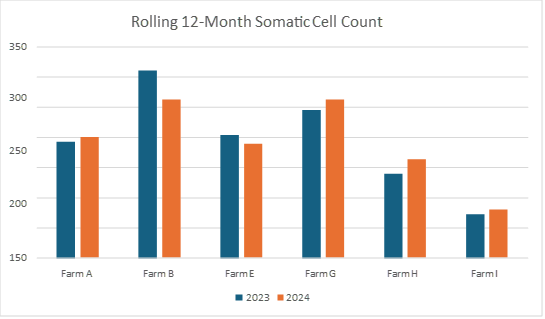
Farm B saw the most significant reduction in SCC with levels reducing from 310 to 262. SCCs have been a challenge for this farm and was one of the reasons why they joined the project. Some of the other farms have seen small increases or stable levels; these are likely just standard fluctuations. Farm G has seen an increase and cell counts are now over 250. For this farm’s milk contract this is not a concern, as they do not penalize for SCCs at this level, but this SCC is high and will need to be addressed as the farmer continues to implement changes. Putting a financial value on SCCs is difficult as it depends on the level at which the individual milk contract imposes penalties/bonuses, and what ppl those stand at. Farm B has penalties imposed at a fairly low SCC, and produces a large volume of milk therefore an extra 0.5ppl is a significant sum of money and would quickly pay for the changes recommended by James. In contrast Farm B sees no penalties or bonuses until SCCs are exceptionally high, and is a very small herd so 0.5ppl is a much smaller sum of money. However, in a small herd there is less of a dilution, so stopping one cow having a high SCC or curing her during the dry period may have a big impact on the herd’s overall bulk milk SCC.
Conclusion
The project has now concluded (final data analysis is currently being run by James and will be presented as a supplement). Many mastitis issues take considerable effort to resolve and may also be timely e.g. require a year to pass so that winter housing can be assessed, changed, and the cows can then pass through the housed period before data is available.
Due to the short nature of the project the true impact of James’s analysis and advice cannot be fully seen in this report. However this can be seen where farmers fully engaged and included their vets real progress.
Farm B has seen a reduction in mastitis incidence from over 100 cases per 100 cows in January 2024 to 40 cases per 100 cows in December 2024. If those figures were rolling this would be a decrease form 730 cases to 292. At a cost of £314 per case this is a potential annual saving of £137,532.
The project reinforced the importance of quality data recording and of following aseptic technique for milk sampling. It also highlighted how important it is to use data collected on the farm for decision making processes and not to collect it for no reason.