

What causes ewes to lose body condition and what can be done to reduce the impact of thin ewes on farm?
Farming Connect Advanced Sheep Discussion Group Project Report, Flock Health Ltd
Introduction
Sheep farming is a significant agricultural sector in the UK. In June 2024, the UK flock comprised approximately 31 million sheep, including 15.2 million lambs under one year old. The UK sheep farming sector was valued at approximately £1.3 billion in 2020.
Ewe performance is critical; reduced production from breeding ewes results in lost potential for lamb meat and revenue. Optimizing production, profitability, and efficiency yields benefits for flock health, business, and the environment. Ewe performance is assessed by the ability to produce optimal output (lambs reared) at minimal cost.
Reduced lamb output results from increased numbers of empty ewes, abortion issues, or higher lamb mortality. Thin ewes are less fertile, have reduced milk supply, and are more likely to be culled, increasing costs. Ewe efficiency relates to flock longevity and annual lamb production. Reduced body condition has multiple causes, often investigated only when many younger ewes lose condition. Identifying and screening for causes of body condition loss reduces disease impacts.
The ‘Iceberg’ diseases
The Iceberg diseases are a group of sheep diseases, either viral or bacterial, that typically have a long incubation period and cause loss of body condition, reduced production and increases in ewe mortality. These diseases are termed ‘iceberg’ due to their insidious nature, where the obvious clinical signs are much less impactful than the hidden impact of subclinical disease.
The respiratory viruses cause infectious lung tumours in the case of Ovine Pulmonary Adenomatosis (OPA) or progressive pneumonia, neurological signs and indurative mastitis in the case of Maedi Visna (MV). Border disease (BD) virus/Bovine Viral Diarrhoea is a virus causing reduced fertility, the birth of weak lambs, stillbirths and immunosuppression. Infection of the pregnant ewe can lead to the development of a persistently infected lamb which may be born apparently normal but continue to shed the virus throughout its lifetime, leading to ongoing reduced flock performance.
Ovine Johne’s Disease (OJD) is a bacterial iceberg disease that causes a chronic enteritis with associated loss of protein. It is an important cause of economic loss in UK sheep flocks and thought to have a prevalence of around 64% in sheep flocks across the UK. Caseous Lymphadenitis (CLA) is a chronic bacterial disease, causing infection and inflammation of lymph nodes. In the UK, it is typically seen in the superficial cutaneous skin form but can also occur in internal visceral lymph nodes and lead to wasting.
Project aims
This project sought to investigate the cause of thin ewes on individual farms by assessing the prevalence of ‘iceberg diseases’, parasite or other reasons for loss of body condition in younger ewes in the flocks of a self-selected project group of farmers from across Wales. The project aimed to directly benefit the participants but also the wider Farming Connect group of farmers via knowledge transfer of the results. The individual farm results were anonymised before results were shared.
Project participants
The discussion groups have gained traction over the previous two years, whereby developing trust and confidence has enabled farmers to share their flock information freely and without judgement. Discussion group members have participated in numerous meetings where the causes of thin ewes have been discussed, and as a result, knowledge and awareness have been improved.
There are 120 farmers who attend eleven Flock Health Ltd Discussion Groups throughout Wales. In December 2024, a cohort of 45 of those farmers voluntarily completed a questionnaire that revealed they kept a total of 21185 breeding ewes (mean flock size 471 ewes; median 420; range from 30 ewes to 1969). In 2024, these 45 flocks had an average ewe to ram ratio of mean 46 (median 40; range 5 to 104) and scanned the ewes at a mean of 154% (median 160%; range 97-200%). Each flock had a mean of 5% (range 1-13%) of empty ewes after scanning 2023/24. There were 4 flocks out of 40 that did not scan the ewes.
Methods
A group of farmers were selected from sheep discussion groups across Wales who responded to a questionnaire showing interest to assess thin ewes and overall flock efficiency within their flock.
Twenty-seven farmers answered a questionnaire to gather information around flock age structure, replacement rates, known presence of disease, specifically the ‘iceberg diseases’, liver fluke infection, sheep scab and Haemonchus contortus infection. The project provided funding to allow for a conservative amount of diagnostic testing, which included the disease screening of the thin ewe group from the flock and the option of three thin ewes for postmortem.
Two Welsh veterinary laboratories were used to perform the testing and postmortems. These were APHA Carmarthen Veterinary Investigation Centre and Wales Veterinary Science Centre Aberystwyth. Submitted ewes were not included in the project if there was an obvious cause of ill thrift, such as they were lame or had mastitis.
Eleven project farms submitted three ewes for post mortem examination, and one farm submitted one ewe. The ewes were all alive at the time of selection, and they were then either euthanised at the post mortem facility or euthanised on the farm and collected by the collection service and taken to the post mortem facility. Post mortem investigations were conducted as per the individual laboratory protocols. Histology was used alongside other testing to confirm the presence of disease, and further testing was performed to exclude or diagnose disease at the discretion of the veterinary pathologist.
All project farmers were encouraged to send pooled faecal samples from a group of up to 12 thin ewes. Twenty-one farmers collected faecal samples and submitted them to APHA Carmarthen Veterinary Investigation Centre. These samples were tested using sedimentation for the presence of liver fluke and rumen fluke eggs, the presence of Johne’s disease Mycobacteria paratuberculosis via a polymerase chain reaction (PCR) test, and a faecal egg count (FEC) was performed. Where the FEC count was deemed high enough for further testing (above 200 epg), a peanut agglutination stain was performed to assess the percentage of Haemonchus contortus eggs in the sample.
Five flocks also had blood samples taken from 12 thin ewes, and ELISA tests for Maedi Visna (MV) and Caseous Lymphadenitis (CLA) were performed. Cost limitations and logistics limited the number of samples that could be taken from each flock. It would have been preferred to test 12 thin ewes in all flocks for Maedi Visna. However, screening using faecal testing and the post mortem examinations allowed useful information at the farm level and provided focus for further investigation.
Results
Initial Project Survey
- Flock Profile: The questionnaire asked the project farmers for flock information relating to the performance period from tupping 2022 to tupping 2023. The average flock size for the farms in the project was 651 ewes (range 75 to 2100 ewes). Seven out of 27 farms put ewe lambs to the tup in 2022. The average percentage of 1.5-year-old ewes, 2.5-year-old, 3.5-year-old and 4.5-year-old and above ewes put to the tup was 29.2%, 25.2%, 20.6% and 23.1% respectively.
- Awareness of iceberg diseases and parasites: The questionnaire sought to establish the current level of awareness of iceberg diseases and potential causes of thin ewes with reference to the farmers' own knowledge and previous history of these diseases on their farms. The project farmers have all been members of Farming Connect discussion groups for at least 2 years and will have attended previous meetings on the causes of thin ewes. Almost all farmers had some knowledge of Ovine Johne’s Disease (OJD) and Maedi Visna virus (MV). Four of the farms had previously tested positive for OJD, and four farms had tested for Maedi Visna virus but had not had it confirmed. All the project farmers were also aware of and had some knowledge of Border Disease virus, liver fluke, sheep scab and Haemonchus contortus, and a small number had previously had positive results. Five out of 27 and seven out of 27 had no awareness or knowledge of Ovine Pulmonary Adenomatosis (OPA) and Caseous Lymphadenopathy (CLA) respectively. OPA had been identified previously in 3/27 of the farms, and CLA had not been tested or identified.
- Post mortem examinations from 11 farms: A range of diseases and conditions were found in the ewes that were submitted for postmortem. Eleven out of twenty-seven flocks submitted three ewes (one flock submitted one ewe only) for post mortem examination. Twenty-one out of 27 flocks submitted faecal samples to the laboratory for testing. A range of diseases and conditions were identified across the project flocks. Figure 1 identifies the percentage of flocks where these diseases were identified in one or more of the ewes from that flock at post mortem examination.
| Disease | Percentage of flocks affected (11 flocks) |
| Ovine Johne’s disease | 36% |
| OPA | 18% |
| Chronic liver fluke infection | 18% |
| Haemonchus Contortus worms | 9% |
Figure 1. percentage of flocks where these diseases were identified
Maedi Visna virus, Border Disease virus and CLA were not diagnosed in any of the 11 flocks at post mortem.
Figure 3 shows the percentage of the 11 flocks concurrently affected by another pathology in addition to the iceberg disease identified in figure 1. Interestingly, 64% of the flocks had one or more ewes with poor molar (cheek) teeth. Abnormalities included a combination of dental disease, absent teeth, loose teeth, ‘wave mouth’ where the teeth are poorly aligned, firm swellings, ‘bony’ reaction on the mandible (jaw) and tooth abscesses. Poor incisor teeth were also reported, but they have not been included in this graph. The impact from dental disease and poor dentition from molar teeth is considered to have a significant impact on body condition.
| Other pathology identified | Percentage of flocks (11 flocks) |
| Poor dentition (molar teeth) | 64% |
| Parasitic gastroenteritis (PGE) | 55% |
| Chronic lung abscesses | 36% |
| Mycoplasma ovipneumoniae | 36% |
| Dictyocaulus filaria (lungworm) | 27% |
Other pathology identified Percentage of flocks (11 flocks) Poor dentition (molar teeth) 64% Parasitic gastroenteritis (PGE) 55% Chronic lung abscesses 36% Mycoplasma ovipneumoniae 36% Dictyocaulus filaria (lungworm) 27%
Figure 2. Flocks affected by another pathology in addition to iceberg disease
Damage of the gastrointestinal tract from parasitic gastroenteritis (PGE) was identified in one or more ewes in 55% of the flocks.
- Faecal examinations of post mortem ewes
The ewes that were postmortem examined also had individual faecal egg counts performed. These are described in figure 3.
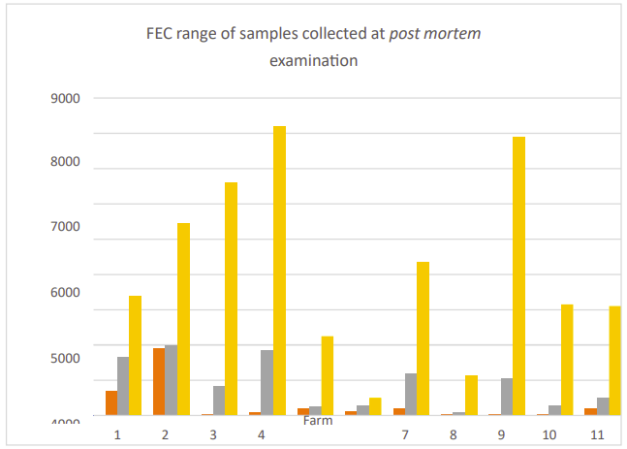
Figure 3. FEC range of samples collected at post mortem examination
The individual faecal egg counts show a striking variation in the counts from each of the three ewesfrom the same thin ewe group of sheep on each farm. This poses interesting questions around the management of thin ewes as a group and the variations that maybe occurring at an individual animal level.
- Faecal egg counts from groups of ewes on farm
FEC range of samples collected at post mortem examination 9000 8000 7000 6000 5000 4000 1 2 3 4 Farm 5 6 7 8 9 10 11 Of the 21 flocks that submitted pooled faecal samples to APHA Carmarthen, 52% had rumen fluke eggs detected and 33% had liver fluke eggs detected. 48% of the samples had a pooled FEC of over 500 epg and 43% of the samples were positive for Haemonchus contortus (see figure 5). Of those that had Haemonchus eggs detected, the range in percentage of contribution to the total count was low between 1 to 9%. 24% of the samples were positive for Ovine Johne’s disease.
The samples were submitted from August to November, with liver fluke eggs detected samples submitted throughout this period. This is indicative of the presence of adult fluke, which maybe from early infection in the summer or from adults that have survived in the liver from the previous year.
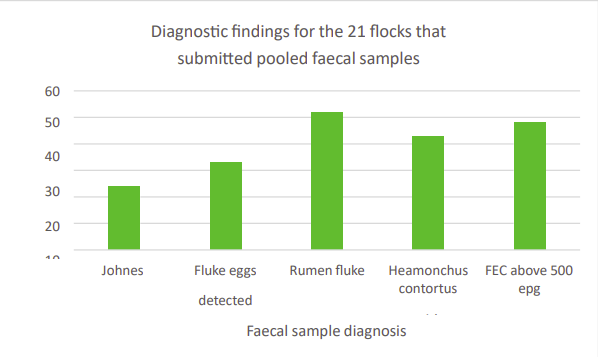
Figure 4. The percentage of flocks diagnosed with Ovine Johne’s disease and parasite detection in the 21 flocks submitting pooled faecal samples.
Five farms had blood samples taken from the thin ewe group on their farm. One farm had blood samples submitted from a thin ewe group of nine ewes. Unfortunately, they presented with high levels of Maedi Visna antibody ELISA positive animals (7/9 samples) and one CLA antibody ELISA positive. One farm had 2/12 positives for MV and 1/12 positive for CLA. One farm was negative for MV but had two positives for CLA. Two other farms had bloods sampled for MV and CLA which were negative.
Discussion
This project investigating thin ewes in Welsh sheep flocks revealed a complex mix of contributing factors. The initial survey showed variability in flock performance, with some flocks struggling with high barren ewe rates and lamb mortality. Awareness of iceberg Diagnostic findings for the 21 flocks that submitted pooled faecalsamples 60 50 40 30 20 10 Johnes Fluke eggs detected Rumen fluke eggs Heamonchus FEC above 500 contortus positive epg Faecal sample diagnosis diseases differed, with farmers generally familiar with OJD and Maedi Visna, but less so with OPA and CLA.
Postmortem findings highlighted several health issues linked to poor condition. Ovine Johne’s Disease and chronic lung abscesses were significant. Poor dentition was prevalent, impairing feed use, particularly in older ewes. Parasitic gastroenteritis and internal parasites were common, with Haemonchus contortus found in some flocks, raising concerns about anthelmintic resistance.
Faecal egg counts varied within thin ewe groups, stressing the need for individual assessment. The presence of Haemonchus contortus, even at low levels, is clinically important.
The study confirms that thin ewes result from multiple factors. Subclinical disease, parasitism, poor dentition, and management all play a role. Addressing this requires a comprehensive approach: better disease surveillance, parasite control, attention to ewe nutrition and dentition, and proactive culling. Further research on iceberg diseases, especially OPA, is needed. These findings improve understanding of factors affecting ewe condition and highlight areas for intervention to enhance flock health and productivity.