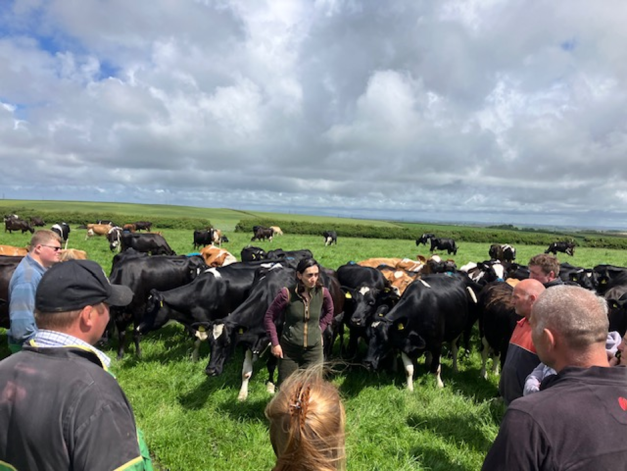
Discussion Group Projects:
- Funded projects run for 12 months, followed by six months for writing up the results.
- Soil health
The Cardigan and District Grassland Society discussion group project, led by Menna Williams, is titled “Enhancing Soil Mycorrhizal Fungi through Molasses Supplementation.” The project is applying liquid molasses to grassland soils and using soil testing before, during, and after treatment to measure changes in mycorrhizal fungi. Its intended outcomes include improved grassland productivity and forage growth, greater drought resilience, increased soil organic matter and overall soil health, and reduced reliance on artificial nitrogen and phosphorus fertilisers.
- Sheep parasite control
The sheep sector parasite species identification project brings together discussion groups from Brecon, South Wales, and Pembrokeshire. The project aims to improve targeted worm control by collecting faecal samples, conducting faecal egg counts, and using faecal culture techniques to identify worm species before and after anthelmintic treatment. APHA vets will conduct the culture analysis so treatment efficacy can be assessed. This project is supported by Non Williams.
- Wireworm control
The Puffin discussion group project, covering Pembrokeshire, Ceredigion, and Carmarthenshire and led by Gwyn Davies, is titled “Developing sustainable wireworm control through Integrated Pest Management.” In collaboration with Fera Science’s wider UK project, the group is monitoring wireworm and click beetle populations under commercial farming conditions, validating DNA metabarcoding for faster species identification, assessing risks linked to soil type, crop rotations, climate, and landscape characteristics, and tests controls such as cover crops, seed mixes, and methods for encouraging natural predators. Expected outcomes include more cost-effective species identification, improved understanding of field-level risks, and evidence-based pest-management recommendations.
- Dairy feed and phosphorus
- The Dairy Celts discussion group project, covering Pembrokeshire and Carmarthenshire and led by Ffion Evans, is titled “Does lowering phosphate in feed mean a lower phosphate in manures without affecting efficiency?” The project’s objective is to test a hypothesis that phosphate levels in dairy cattle feed are significantly above biological need, and that a reduction in feed phosphate will reduce phosphate levels in manure and thus decrease Phosphate surpluses lost to soil and water. The data & learnings generated could thus apply to a much wider dairy farming base than just Dairy Celts.