

- Status:
- Complete
- Farmed by:
- Sarah Hammond and Robert Williams
- Location:
- Ffermydd Glyn Arthur, Llandyrnog
- Sector:
- Sheep
Overview
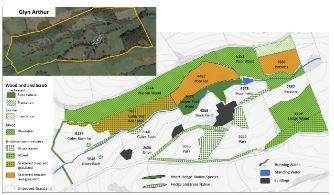
The land at Glyn Arthur occupies a valley running East to West down from the Hill fort of Moel Arthur, part of the Clwydian Range in Denbighshire. The land extends over the hill to the North, and South into the smaller neighbouring valley of Gales Uchaf, in total around 400 acres. Approximately 30% is unimproved and semi-improved hill and 35% improved grassland, some mowing and some exclusively grazing. Woodland and trees make up close to 15%, but there are also numerous veteran parkland, hedge trees, and key habitat of Wood pasture, plus heath and now rare, unimproved grassland.
There are a number of areas of broadleaf and conifer woods, both fenced and open to grazing, some damp woodland, parkland trees and an impressive number of veteran trees of several different species; Oak, Willow, Larch, Alder and a very old Walnut near Gales Uchaf.
The enclosed stands of trees are varied in species, with stands of Larch, Fir and mixed deciduous. Most have a dense understory of ferns and bramble. The woodland was last felled during the First World War. European Larch was then planted during the 1960s. Bluebells are also found in some areas which are an indicator of ancient woodland.
The project aims to develop a practical management plan for the woodland area which will provide an additional income stream to the farming business. The plan would consider several management options:
- Restoration of native woodland
- Thinning to free up mature trees being swamped by undergrowth
- Thinning to favour conifer continuous cover forestry
- Heavy thin and shelterwood to pre-empt possible larch disease
- Clear fell Douglas fir to raise income and change to native woodland
- Thin to enhance timber quality in alder stands
- Fence to exclude stock to increase ground flora and biodiversity value
- Management of veteran European larch as raptor nest sites
The project will also contribute to the Sustainable Land Management outcomes including:
- Resource efficiency
- Resilient ecosystems
- Reduced greenhouse gas emissions
- Protected natural landscapes and historic environment
- Clean Air, Reduced GHG emissions, Maximise carbon storage
- Clean Water, Mitigate flood & drought risk
Latest Project Timeline
Final Update
Key results:
- The woodland management plan at Glyn Arthur has resulted in 228 tonnes of timber being extracted in the first thinning and averaged at £75/ton for the timber sales against a cost of £55/ton for felling and extraction and £13/ton for haulage from woodland to roadside. This equates to £2,791 additional income for the farm after taking into account the contractor costs.
- Post felling will produce enhanced timber quality and yield through selective thinning, focusing on older stands in Lodge Wood producing a rapid quality increment. The estimated timber volume increment per year is 20.1m3/ha.
- Glyn Arthur has gained knowledge and confidence to continue the woodland management regime on their farm woodlands.
Background:
The farm woodland at Glyn Arthur is approximately 20 hectares (ha), comprising mixed conifer plantations, semi-natural woodland, and historic parkland with scattered mature trees. Over the past 50 years, self-thinning has occurred in mixed plantations due to competition, pests, and diseases.
This project focuses on creating a comprehensive woodland management plan to generate extra income for the farm.
The plan has considered several management options:
- Restore native woodlands and thin out overgrown areas to benefit mature trees.
- Implement a thinning regime to transition towards continuous cover forestry.
- Restore planted ancient woodland sites (PAWS) by restocking with diverse species, ensuring future timber resources for the farm.
Purpose of the work:
- To develop a management plan which will engage with sustainable land management options to improve green infrastructure on the farm to increase and improve carbon sequestration, biodiversity, water and air quality and incur revenue by utilising the multifunctional benefits that trees provide. Key to this will be to improve woodland condition and bring the woodland back as an active asset for the farm business.
- Explore markets for a range of available species and investigate adding value to timber as a milled resource for the farm.
- The CCF approach is the chosen strategic decision made for long-term ecological and economic benefits. This will forge creation of a diverse species mixture across the entire woodland, blurring traditional compartment boundaries.
What we did:
- Round table discussion to identify Glyn Arthur’s objectives and future vision
- Produce action plan timetable to track progress and timetable key discussion meetings when required
- Review and interpret woodland assessment survey
- Submit request for inspection of Larch to NRW
- Submit felling licence to include details of restocking felled areas
- Create a woodland management plan and submit to NRW for approval
- Produce an Irregular Silviculture network report based on selected plot measurements undertaken in the woodlands to assess individual tree species health and quality status.
- As Glyn Arthur has commissioned a contractor prior to the project starting a meeting was organised to discuss the program of works and extraction route.
- Sample plot marking of timber in Lodge wood and training provided for Sarah
- Continued liaison between NRW and plan author to ensure target approval date.
Outcomes:
The project has resulted in:
- Establishment of baseline data to track the evolution of species mixtures and tree sizes as stands transition to continuous cover.
- Shift from unmanaged, single-species, even-aged woodland to a mixed-age, mixed-species woodland at Glyn Arthur which has increased resilience to climate change impacts.
- Halo thinning has reduced the competition and protects parkland veterans root systems while thinning conifer elements.
- The management plan included rapid intervention to reduce growing larch stock, improve stem quality, and diversify species through enrichment planting due to disease threat. Also, selective thinning to remove trees with Ash die back and conserve resistant individuals, promoting ventilation and crown development to build disease resistance
- The woodland management plan at Glyn Arthur has resulted in 228 tonnes of poorer quality timber being extracted in the first thinning and averaged at £75/ton for the timber sales to six different buyers in the local supply chain.
- This equates to £2791 additional income for the farm after taking into account the contractor costs.
- Post felling will produce enhanced timber quality and yield through selective thinning, focusing on older stands in Lodge Wood producing a rapid quality increment. The estimated timber volume increment per year is 20.1m3/ha, Table 1.
Table 1. Annual value increment
Lodge wood | £/ha |
Land value | £5,000 |
Standing timber value | £17,100 |
Potential timber value | £26,902 |
Total standing value | £22,100 |
Total potential value | £31,902 |
Annual value increment | 807 |
How to apply the woodland management plan on your farm:
- Speak to your Farming Connect local Development Officer to discuss how to develop your own woodland management plan with the support of woodland specialists
- Confirm funding sources (grants, farm income) and allocate funds for each planned activity.
- Determine if you have the in-house skills and capacity to carry out the work. If not, identify external contractors (foresters, arborists, machinery operators).
- Explore possible sale avenues for a) standing timber or b) timber at roadside. This could coincide when sourcing contractors to undertake the work.
- Permits and Regulations:
- Felling Licences: Ensure all necessary felling licenses are in place before any tree felling commences.
- Environmental Regulations: Understand and comply with regulations concerning protected species, water quality, ancient woodland, and archaeological features.
- Health and Safety: Develop a robust health and safety plan for all woodland operations, including risk assessments for each task.
Please contact timtechnegolcff@mentera.cymru if you would like to receive a copy of the full final report for this project.