

Requirements that agricultural contractors need to adhere to for SFS agreements in Wales.
This page summarises the key legal and scheme-specific requirements contractors must follow when managing hedgerows for farmers participating in the Sustainable Farming Scheme (SFS). Non-compliance can result in sanctions for the farmer, so contractors must follow these rules precisely. These requirements are based on current 2026 rules only and could be subject to update depending on scheme development.
- Do NOT cut or trim the same hedgerow in successive years. You cannot
cut a hedge two years in a row. This is because many woody hedge species,
including hawthorn, flower on second-year growth. Retaining older growth
increases the availability of flowers and fruit for farmland wildlife. - This applies to BOTH sides of the same length of hedge. You cannot cut
one side in Year 1 and the other side in Year 2. - You may cut encroaching bramble outside the hedge profile if needed for
animal health and welfare. - Biosecurity & machinery hygiene: Consider cleaning machinery to prevent
spreading invasive species or plant diseases between farms where there is a
high risk.
Permitted exemptions (Annual cutting allowed):
- Overhanging hedges or trees affecting highways, roads, tracks, or footpaths
where cutting is required for safety. - Cutting as part of routine ditch maintenance on improved land.
- Utility companies may cut hedges or trees affecting electricity or telephone
lines. - Hedge restoration (laying or coppicing and gapping-up) may be carried out in
March, provided nesting birds are not knowingly disturbed. - Ensure that an approved felling licence, where required, is in place prior to
coppicing hedgerows. (check felling guidance) Hedge restoration for competitions or training events is allowed up to 30 April,
with written permission from Welsh Government and compliance with the
Wildlife and Countryside Act 1981.
- No cutting or trimming between 1 March and 31 August (unless exemptions apply). This is a requirement under the Universal Code.
- Each time a hedge is trimmed, it must be cut to a slightly higher and wider
point than before. This avoids concentrating regrowth t the same height,
which can weaken the hedge structure over time. - Aim for at least 5cm incremental growth per trimming cycle.
- Once the hedge reaches 3m x 2m (or 2m x 3m), you may maintain it at that
size but it can still only be cut every other year. In exposed coastal or upland areas where growth is slower, the incremental
growth requirement still applies, even if 5cm cannot be achieved.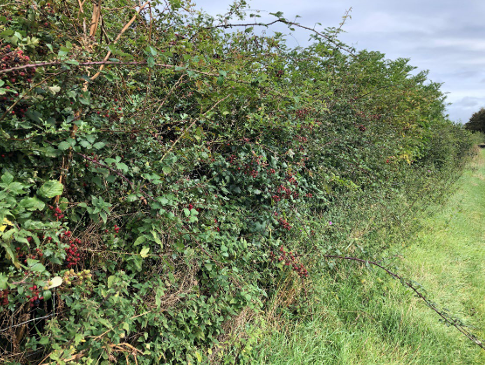
Untrimmed hedgerow from the previous year providing a food source for wildlife and a denser structure that’s fit for purpose.
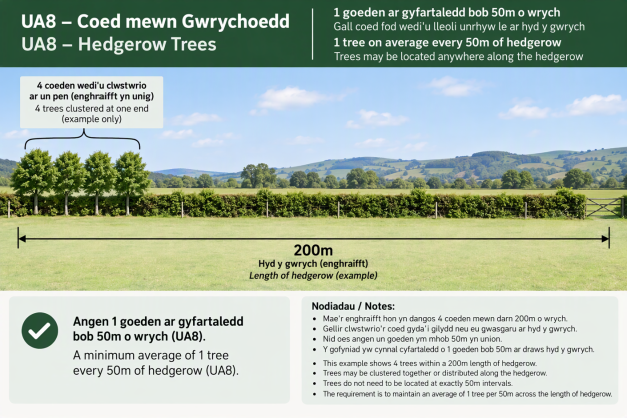
Maintain or establish one hedgerow tree per 50m on average of hedgerow (calculated per field parcel). Example: A 200m hedgerow should have a minimum of four hedgerow trees somewhere along its length. Safeguarding hedgerow trees: Do not cut or damage hedgerow trees. Identify and avoid young saplings marked for retention.
Contractors must support farmers in keeping accurate records:
- Keep an activity diary of all hedgerow work, including dates of cutting, trimming, and planting.
- Retain photographs and letters/emails from authorities or utility companies explaining why more frequent cutting was necessary.
- Records must be kept for 5 years and be available for inspection.
Importance of farmer - contractor communication
Effective hedgerow management under the SFS largely depends on clear, proactive communication between the farmer and contractor. Before any work begins, both parties should discuss:
- Which hedges were cut last year
- Which hedges must NOT be cut this year
- The intended cutting line to achieve incremental growth
- Locations of hedgerow trees and tagged saplings
- Any planned restoration work (laying/coppicing and gapping-up)
- Areas with ground-nesting bird constraints. This may affect the requirement to
establish new hedgerow trees - Safety-related exemptions (roads, utilities, access)
- Required evidence and record-keeping
A short conversation can help prevent accidental breaches, protect the farmer’s SFS payments, and ensure contractors deliver work that meets the environmental and legal standards expected under the scheme.
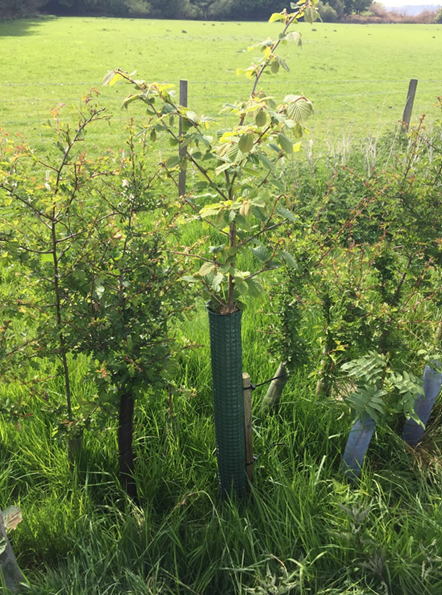
Location of hedgerow tree and tagged sapling - Planted hedgerow tree safeguarded with an appropriate tree guard to promote successful establishment and facilitate identification as a hedgerow tree.
QUICK CONTRACTOR CHECKLIST
- Confirm SFS hedgerow commitments with farmer
- Check cutting dates
- Identify and avoid damaging hedgerow trees
- Set machinery height correctly
- Record all completed work