

Contents
Not all light is equal. How different light wavelengths impact indoor dairy herds
April 2026
Name of author(s): Carla Barennes1, Tyler Stevenson1,2, Hannah Rees2,3
Affiliations: University of Glasgow1, BioClocks UK2, IBERS, Aberystwyth University3


|
Across the UK, around 40,000 dairy cattle are reared indoors for the whole year. In this article, we discuss how lighting in barns can be used to maximise the health of dairy cattle and optimise milk productivity. We focus on two aspects of lighting used in sheds, namely their wavelength and intensity.
How light influences daily rhythms in dairy cattle physiology and welfare
Most farms rely on transparent ridge skylights or open longitudinal curtain walls to maximise sunlight penetration into the building during the day. These are often supplemented with artificial indoor lighting using fluorescent, incandescent, or light emitting diode (LED) bulbs.
Natural light includes a broad range of light wavelengths. However, one specific wavelength (light blue at around 450-500 nanometres) is the primary frequency used by dairy cattle to regulate their daily rhythms. This frequency of light is sometimes called “melanopic light”.
Three types of light sensitive cells (photoreceptors) exist in the cow retina; rods, cones and photosensitive retinal ganglion cells (ipRGCs). Cows are dichromats, meaning that they have cones which can differentiate between short (blue) and medium (yellow) wavelengths, but struggle to see light in longer wavelengths (red). They also have a high density of rod cells which enhance vision in dim light conditions, thus facilitating foraging at dusk. The third type of photoreceptor, ipRGCs, are responsible for detecting melanopic light. These cells pass information on to the suprachiasmatic nucleus (SCN) in the brain (Figure 1). One job of the SCN is to regulate the hormone melatonin. In the dark, melatonin is synthesised and travels throughout the body to signal the night-time environment. Changes in melatonin production affect various physiological rhythms such as the cow’s stress response, immune function, metabolism, reproduction and lactation.
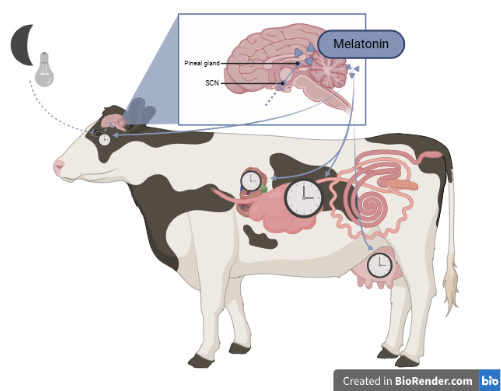
Fig 1. Light, or the absence of light, is detected by the eye and controls melatonin regulation of cattle physiology
The importance of darkness:
Night-time melatonin has many health benefits for cows, with antioxidant and immune stimulatory properties, thus reducing somatic cell count (SCC) in milk, as well as roles in cardiovascular, lipid metabolism and heat stress regulation. Melatonin also stimulates progesterone, positively influencing reproduction by enhancing oocyte health – namely: reducing reactive oxygen species (ROS) and speeding up maturation, and embryo development which results in higher pregnancy rates.

The impact of different light wavelengths:
Usually, with artificial lighting, the aim is to replicate the colours and brightness of natural light as closely as possible. Blue light is particularly important in the morning for resetting daily cycles and increasing cattle alertness but should be avoided during the dark period. Green light enhances cattle vision, reducing the risk of injuries like hock lesions and tail lacerations, and may reduce stress in situations like transport. Yellow light may have positive impacts on feed intake in calves (Table 1).
In some situations, artificial lighting can be manipulated to facilitate farm management while reducing disturbance to cattle. Low intensity red light can be used for night-time checks as human farm workers can see what’s going on with minimal re-setting of the body clock in cattle.
Increasing wavelengths 
| LED wavelength | Advantages | Disadvantages |
 Blue |
|
| |
 Green |
(given to calves; compared to blue or red light) | ||
 Yellow |
(Yellow light given to female dairy cows late in the day; compared to white light) | ||
 Red |
| ||
 White |
|
|
Table 1. Positive and negative impacts of different light wavelengths

Summary
If you’re going to refurbish your lighting ready for next winter, you may want to keep up to date with the up-and-coming technology. Organic LEDs (OLEDs) are promising customisable technologies, with LEDs with tuneable brightness and colour spectra offer opportunities for improving cattle welfare and productivity while cutting energy bills. Some systems also come with automatic programming, taking the management pressure off farm workers.