

26 February 2026
Genomically testing crossbred heifers and first lactation cows has identified a big range in fertility and milk solids potential at a Welsh dairy farm, arming the business with valuable data on its split-block calving herd.
The Edwards family screened 113 replacements and younger cows as a Farming Connect Our Farms network project, with the ambition of fast-tracking genetic gain.
Until recently, it was only possible to evaluate genotypes from purebred dairy cows, but this system now extends to crossbreds too, offering greater numbers of farmers the opportunity to drive genetic improvement in their herds.
For father and son, Alun and Eurof Edwards, who produce milk at Rhydeden, Abergele, it will inform breeding decisions in 2026.
Their constituent contract with South Caernarfon Creameries is based on the fat and protein content of milk and therefore they are breeding for these traits.
Milk yield averages 5,900 litres a cow at 4.8% butterfat and 3.88% protein, producing a milk solids average of 528kg from a concentrate input of 1.1t /cow/year.
Across the 113 animals genomically tested, protein ranged from 0.04 to 0.36%, fat from -0.01to 0.59%, and the female Fertility Index (FI) from 2.4 to 20.6. This large variation highlighting the difference in performance potential of individual animals.
The data will underpin decisions on which animals to breed from in May 2026, says third-generation farmer Eurof.
“Previously we would select blindly, certainly with the heifers, just looking at parentage, but based on this new genomic data our breeding decisions this spring will be different to those we might otherwise have made; they will be more targeted.
“We hadn’t necessarily been missing the better animals before, but we were probably breeding below-average heifers while overlooking our top 70 cows and 70 heifers.’’
Targeted breeding will help improve herd efficiency and, ultimately profitability, Eurof adds.
“It has been a really straightforward way of collecting data on our cows, it will make it simpler to breed to improve the herd and for very little cost compared to other investments, and to good effect too.’’
The project utilised NMR’s GeneEze ear notch tissue testing, which costs £25.50 an animal.
Up to 70 heifers are reared annually as replacements for the closed herd of 175 spring and 125 autumn calvers at Rhydeden, a system the Edwardses transitioned to from an all-year-round system.
With an empty rate of just five per cent in 2025, the replacement rate is low.
Historically, the policy has been to breed the next generation only from heifers and what were regarded as the ‘better’ cows, mating these to sexed semen but without really knowing if the heifers had superior genetics to cows bred to beef sires.
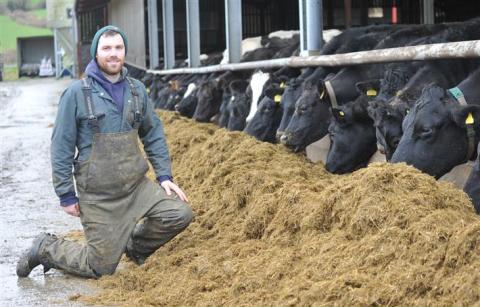
“We just made the assumption that because the heifers had been produced from newer sires, they were better, but genomic testing has shown us that this is not always the case’’ Eurof acknowledges.
“There was a big range, some were poorer on milk and while others really impressed with fertility and percentages of fat and protein which didn’t surprise us because of the type of cow we have, that is the strength of the crossbred.’’
Rhydeden is hilly, and a crossbred is well suited to this, also given the distances of some grazing paddocks from the milking parlour.
“The cows have to walk quite a lot and most of it is uphill so big Holsteins just wouldn’t suit our system,’’ says Eurof, who farms 149 hectares of owned and rented land.
The spring block calving starts on 18 February, with cows turned out to graze as they calve and remain on grass until the end of October. Calving in the autumn block gets underway on 10 September.
Breeding is a slow process therefore it must be right, Eurof adds. “If we can get a better cow and breed for more milk solids then investment in genomic evaluation is a sensible approach.”
“It is a really easy way of looking at what we have. Every farmer can make better breeding decisions quite easily without having really good records or parentage.”
“We always use the best bulls, but we want to breed from our best cows too.’’
Farming Connect Dairy Sector Officer Osian Hughes, who led the project, says the data will enable Rhydeden to compare the ranking of heifers to cow Profitable Lifetime Index (£PLI) ranking which is calculated through milk recording, allowing the best genomic merit cows and heifers to be identified to breed with dairy sexed semen.
PLI in the herd averaged -85, calculated by comparing crossbred heifers that have smaller capacity and milking potential to the AHDB Holstein base.
“Milk yield, protein and fat kilograms were the most significant factors influencing PLI at Rhydeden,’’ says Osian.
The Edwards’ plan is to fully utilise the data captured by the project, and they are likely to continue with genomic testing in the future.
“Data can make us more efficient as farmers,’’ Eurof reckons but adds: “Data is only good if you use it. As farmers we can have data on all sorts of stuff so it is about deciding what data we can use that will improve our business.”