
Final Report - Nitrogen use efficiency for optimal fodder beet yield
Key Results
- Total bulb yield: 17.3 t DM/ha
- Total leaf yield: 3.1 t DM/ha
- Combined forage value: £3,110.93/ha
- Cost of production: £1,616.90/ha
- ROI +92.3%
Background
Fodder beet is one of the highest-yielding forage crops in the UK, offering exceptional energy density and cost-effectiveness. Previous Farming Connect trials (Crickie Farm, 2024) demonstrated significant benefits from primed seeds and late nitrogen applications. This project aimed to compare foliar nitrogen applications with prilled fertiliser to improve nitrogen use efficiency. However, severe drought and incorrect seed supply meant the trial was restricted to prilled nitrogen only.
Purpose of the work
- Original aim: Compare prilled vs foliar nitrogen application efficiency
- Actual: Assess yield and economic return of using prilled nitrogen only
- Provide learnings for future trials and farmer guidance on growing fodder beet for winter forage.
Purpose of the work
- Original aim: Compare prilled vs foliar nitrogen application efficiency
- Actual: Assess yield and economic return of using prilled nitrogen only
- Provide learnings for future trials and farmer guidance on growing fodder beet for winter forage.
What we did
The field was ploughed on 28 April 2025 and following power harrowing and subsoiling, the fodder beet was drilled and rolled on 2 May.
The following nitrogen applications were applied:
- Synthetic (Nitram):
- 6 May: 125 kg/ha → 43.1 kg N/ha
- 8 July: 125 kg/ha → 43.1 kg N/ha
* 5 September: 125 kg/ha → 43.1 kg N/ha (applied during closed period with FACTS advisor justification*)
*Regulatory compliance for late N applications requires FACTS-qualified justification Under the Water Resources (Control of Agricultural Pollution) (Wales) Regulations 2021, Section 1.2.3 – Closed periods for spreading manufactured nitrogen fertilisers sets out the conditions under which nitrogen may be applied during restricted periods.
- Organic manures (24 April):
* Cattle FYM: 10 t/ha → 6 kg N/ha
* Layer manure: 6 t/ha → 57 kg N/ha
This equated to a total N applied of ~192.3 kg N/ha.
Bulb and leaf yield were measured from the field and soil moisture monitored throughout the project through Paul-Tech sensors.
Fodder beet nutritional values (ME and CP) were referenced from the Crickie Farm trial.
Outcomes
- Bulb DM yield: 17.3 t DM/ha
- Leaf DM yield: 3.1 t DM/ha
- Nutritional profile (indicative): Bulbs ME 13.1 MJ/kg DM, CP 7%; Leaves ME 12 MJ/kg DM, CP 26.2%
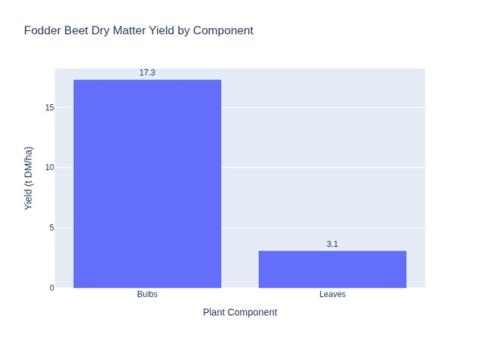
Figure 1. Yield of Fodder beet components in tonnes dry matter per hectare, measured using actual DM%, measured by sending fresh samples to Sciantec laboratory.
Foliar nitrogen:
- Foliar nitrogen comparison was not conducted
- Drought and soil variability contributed to a decision to abandon initial trial objectives of comparing prilled and foliar nitrogen efficiency. As can be seen in figure 2, the plant available at water levels at 20cm depth fell below 10 on the 9 July causing the Fodder beet drought stress.
- The plant available water level remained in the light to severe drought stress for 56 days between the start of July and end of September.
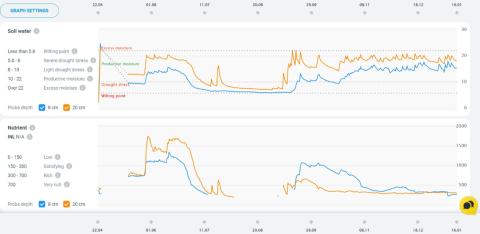
Figure 2. A screenshot taken from the Paul-Tech soil sensor dashboard showing season-long data for plant available water levels (Soil Water) and overall nutrient content of the soil (Nutrient) at depths of 8cm (blue) and 20cm (orange). Gaps in the plotting of the graphs are due to sensors being removed for ploughing (late April) and soil moisture content being too low to calculate Nutrient levels (August).
Return on investment
Table 1. Return on investment
Metric | Value |
Cost of Production (£/ha) | £1,616.90 |
Total Forage Value (£/ha) | £3,110.93 |
ROI (%) | +92.3% |
As shown in table 1, despite significant challenges, the crop generated nearly double its production cost in forage value. This reinforces fodder beet’s economic potential when managed correctly.
How to apply on your farm
- Pick a suitable field which has shelter for the animals from the weather
- Consider using a buffer strip to reduce the risk of run-off
- Consider the use technology (e.g., soil sensors) for informed nutrient management and crop protection
- Timing of herbicide/pesticide application is important as fodder beet is sensitive to weed challenge and is not very competitive in its early stages
- Stick to proven nitrogen strategies until further evidence supports alternatives