

22 January 2025
High quality red and white clover silages have allowed a Welsh sheep farm to shave £1.85/head from the purchased feed bill of twin-bearing ewes.
Concentrate feed was one of the biggest input expenditures at Awel y Grug, near Welshpool, where father and son Glyn and Chris Davies produce lamb from 700 Welsh Mule and Texel-cross ewes.
Cost coupled with an ambition to reduce the flock’s carbon footprint prompted a rethink - their project work within the Farming Connect ‘Our Farms’ network offered the opportunity to trial clover in their system.
That approach yielded significant savings in the 2025 lambing season as figures produced by independent sheep consultant Kate Phillips show the supplementary feed costs reduced by £1.85/ewe in twin-bearing sheep and by £2.31/ewe for singles.
Applied to a flock of 500 ewes scanning at 150%, Kate calculates that at £330/t for an 18% compound feed and £250/t for sugar beet pulp, it would reduce the feed bill by £1,040 in that eight-week housed period.
Further savings were gained from the labour associated with feeding, and from fewer problems at lambing which Kate says resulted from “good strong lambs and high-quality colostrum’’.
On average, forage costs for the eight-week pre-lambing period were about £11/ewe, costed at £149/t DM for the red clover silage and £142/t DM for the white.
Silage quality is the single most important factor influencing how much supplementary feed housed pregnant ewes need in the run up to lambing, Kate explains.
“For every 1MJ reduction in silage ME, ewes will need approximately an extra 10kg of compound feed or home mix.’’
Given the big cost difference between conserved forage dry matter (DM) at 15p/kgDM and 35p/kgDM for compound – the purchased feed costs at Awel y Grug in the 2025 lambing season - it makes economic sense to make high quality silage to reduce purchased feed use, she adds.
The trial compared red and white clover silages fed to ewes in the last eight weeks of pregnancy and the impact on factors such as lamb birthweight, colostrum and lamb growth to six weeks of age.
The silages fed had an average ME of 10.8 MJ/kgDM.
“The energy and protein content varied therefore different supplements were needed to balance energy and protein intakes - the high protein samples simply needed an energy supplement like sugar beet pulp and the lower protein samples some additional protein in the form of a compound feed no higher than 18% crude protein,’’ says Kate.
Twin-bearing ewes consumed an average of 14kg of compound at a cost of £4.62/head or beet pulp at £3.50/head which, when costed at 2024/25 prices, worked out at £5.91/head; in previous years purchased feed consumption averaged 18kg/ewe.
Single-bearing ewes would once have been fed 7kg of concentrates at lambing but with higher quality silage in the system only yearlings had supplementary feed - 4.2kg/head of a compound at £1.39/head.
Ewes lambed from 28 March and Kate reports that birthweights were good and, for the size and breed of ewe, considered “above average’’.
“Single born lambs from mature ewes, whether on red or white clover, had birthweights approaching 5kg, apart from the yearlings which delivered slightly smaller lambs, but this was not unexpected given that they were at least 12kg lighter than ewes in other single bearing groups,’’ she explains.
Twins born to ewes fed red clover averaged 4.24 kg – slightly higher than the 4.18kg of the progeny born from the white clover-fed sheep.
Colostrum quality ests showed all samples exceeded the target Brix score of 26.5%.
For twins, growth rate was fastest in the lambs whose mothers had eaten red clover silage – an average of 227g/day compared to 206g/day in the white clover group.
The trial also showed that finishing times reduced considerably if lambs grazed clover leys instead of permanent pasture.
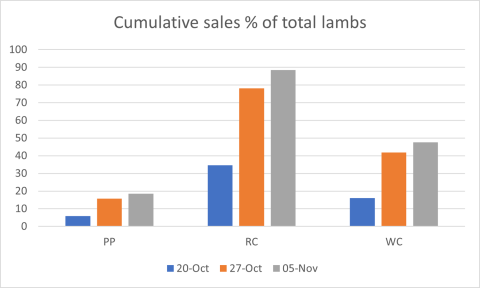
In the three groups assessed from 26 September to 5 November 2025, lambs grazing red and white clover consistently achieved higher DLWGs.
It was the lambs on white clover that grew fastest initially – 109g/day in the two weeks to 10 October.
“Lambs on red clover made a very slow start and seemed reluctant to eat the clover but once they were through the initial two weeks, growth rate increased and lambs were finishing rapidly,’’ says Kate.
The 27 lambs that finished on 19 October grew at 27g/day between 26 September and 10 October, but growth increased dramatically over the next nine days to 217g/day, demonstrating a degree of compensation once fully acclimatised to the red clover.’’
There were only 22% of lambs remaining in the red clover group on 29 October compared to 81% in the permanent pasture group and 42% in the white clover group.
“The trial shows the benefits of red clover in increasing lamb growth rate and reducing days to slaughter when compared to permanent pasture or white clover,’’ says Kate.
High protein content and relatively low rumen degradability are key factors, she adds.
For the Davies’, the savings highlighted by this trial have been significant but across the business, when other factors are considered, they estimate much bigger savings in the sheep system, as much as £8,000 - £10,000 a year.
Chris says that, for example, his work with Farming Connect had given him the knowledge to make better quality permanent pasture silage, and there were other factors that had reduced cost of production including cutting out all creep for lambs.
“We reckon that across the business we are using a quarter of the concentrates we were feeding,’’ he calculates.
“The farm has improved tremendously because of the whole Farming Connect project; it has been unreal.’’
Stronger lamb prices had boosted income, but Chris says this wasn’t the only reason why the business had seen the price paid per head increase by an average of £25 last year.
“By growing clover and improving permanent pasture and rotational grazing we are seeing better lamb growth rates, ewes are performing better.’’
The advice received from both Kate and independent agricultural consultant James Holloway had been invaluable, he adds, and input from Owain Pugh, Farming Connect red meat sector officer for mid Wales, who has overseen the project.
“Owain’s input has been invaluable, he has really spurred us on with his enthusiasm and knowledge and in so doing we are making our business more efficient and sustainable,’’ said Chris.
PANEL
With analysis showing that silage harvested in 2025 exceeded even the very high quality achieved in 2024, it is likely that pregnant ewes will need very little supplementary feed in late pregnancy.
Red clover silages analysed from 11.1 – 11.4MJ/kgDM and white clover 10.8MJ/kgDM.
Protein is high too – the second and third cuts of red clover analysed at over 20% crude.
“For 60kg twin bearing ewes we anticipate feeding very little supplement and perhaps just a small amount of beet pulp, cereals or molasses to help the rumen bugs make full use of the silage protein,’’ says Kate.
“The poorest silage will be offered to singles, either permanent pasture or white clover silage only, and we expect that these ewes will again need no supplements.’’
FARM FACTS
- 129ha of owned land farm
- Land rising to 1200 feet
- Rotational grazing
- 700 breeding ewes
- Lambs sold liveweight through Welshpool livestock market