

Boakashi - Final Update
Key results:
Farmyard manure which was treated with bokashi broke down to a consistency which was easier to handle and spread.
Background:
Boakashi is a Japanese method of composting using Effective Microorganisms in an anaerobic process. This results in a nutrient-rich, pre-digested material that can be used as a soil improver and organic fertiliser. Carreg Farm were interested in trialling boakshi on straw bedding, it was their first time using and had little knowledge of the process of using the product but with increasing popularity around boakshi they were keen to trial.
Purpose of the work:
Promoting Sustainable Farming Practices: We hope to encourage different methods of handling manure and slurry that can lead to the implementation of sustainable farming practices, promoting long-term environmental and agricultural sustainability.
Improving Soil Health: By trialling these methods to compost farm manure, the project has the potential to improve the health and fertility of the soil, contributing to the long-term sustainability of agricultural land.
Improving Agricultural Productivity: By optimizing farm manure management and improving soil fertility, the project aims to boost agricultural productivity, leading to an increase in yield and pasture growth and profitability.
What we did:
Carreg Farm identified a shed which housed suckler cows to split in half, one half was treated with bokashi and the other left as a control. The product used was Agriton Actiferm, which is a mix activated effective micro-organisms applied following the manufacturers dilution and usage recommendations. The project ran from the beginning of November 2023 to the end of February 2024. During this period the shed was mucked out twice with the manure heaped into two separate heaps with the bokashi treated heap covered with a black plastic sheet to create an anaerobic atmosphere. The treated heap was covered for 12 weeks before both heaps were spread out onto grass fields.
Outcomes:
The farmer did not identify any visual difference between the half of the shed that was treated compared to the control area. They used the same amount of straw and did not see any differences in cattle cleanliness.
The main visual difference between the two treatments was after the plastic sheet was removed from the treated heap. Figure 1 has broken down with less straw remaining and a better consistency compared to figure 2.
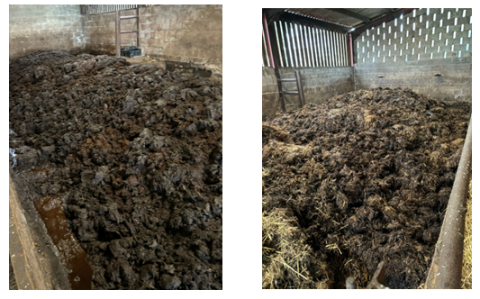
Figure 1. Boakshi treated FYM Figure 2. Non-treated FYM The farmer stated the treated farmyard manure was much easier to handle and when spreading onto the land, it spread much more evenly across the ground, in comparison to the non-treated manure where large lumps of manure were left on the field surface. As a result, the treated manure was incorporated quicker into the soil. A sample of farmyard manure from the treated and non-treated heap was sent to NRM laboratory for analysis, results can be found in table 1.
Table 1: NRM results for the Farming Connect Bokashi study | ||
| Control | Bokashi |
Dry matter (%) | 52.5 | 32.3 |
pH | 8.51 | 8.58 |
Total-N % w/w | 3.16 | 2.61 |
Ammonium-N mg/ kg | 304 | 138 |
Nitrate-N mg/kg | 517 | <10 |
Total-P % w/w | 0.322 | 0.427 |
Total-K % w/w | 5.48 | 4.34 |
Total-Mg % w/w | 0.382 | 0.386 |
Total-S % w/w | 0.411 | 0.347 |
Total-Cu mg/ kg | 52.9 | 102 |
Total-Zn mg/ kg | 85.8 | 128 |
Total-Na % w/w | 0.378 | 0.762 |
Total-Ca mg/ kg | 11804 | 12354 |
How to apply on your farm:
- Bokashi is a new and emerging product. Very little research and scientific studies have been undertaken on the use of bokashi on farmyard manure.
- There are a few companies selling Effective Microorganisms and doing independent research would be advised.
- Undertaking a similar trial on your own farm to identify the effects of bokashi on farmyard manure would be the best route to identifying the possible benefits.
- A lesson learnt from this project would be to sample the farmyard manure before covering the heap. A comparison before and after fermentation can then be made.