

Rhyd Y Gofaint Project update - Final
Key results
- £10,000* increase in profitability due to fertility improvements
- 100-day in calf rate improved from 56% to over 70%
- £1,800 feed savings and less ketosis + metabolic disease due to proactive management of late lactation cow condition
Background
As a rule of thumb, poor fertility costs £25,000 per year in the average performing 100 cow herd (AHDB) which equates to a cost of 3.2 p/litre. Additionally, optimising fertility in the dairy herd will improve carbon footprint. There are a range of causes for poor fertility, varying from farm to farm. Therefore, herds need to be looked at on an individual basis to develop a targeted programme to address these.
Rhyd Y Gofaint farm runs a well-managed herd of 120 Friesian/Holstein cows calving all-year-round near Aberaeron. However, Deryl and Frances Jones are continually looking forward and challenging their system with the aim of being more efficient and sustainable. Kate Burnby, Fertility Specialist, worked with Deryl and Frances to examine their fertility Key Performance Indicators (KPIs) and determine how to further improve fertility management.
Purpose of the work
- To improve fertility performance and overall productivity through targeted interventions
- To increase in the 100-day in-calf rate
- To estimate the economic benefit of improved fertility outcomes
What we did
A review of existing farm strategy plus examination of cows and their environment was conducted to establish short, medium and long-term goals. Together with Deryl and Frances, the whole team identified “quick wins”, and determined keynote KPIs and recording and monitoring protocols.
New protocols
- Regular ketone testing post calving to identify patterns and high-risk individuals
- Regular metricheck at 21-28 days post-calving to identify endometritis – especially subtle endometritis, earlier
- Introduce extra confirmatory PD at 130-150 days including scrutiny of Body Condition Score (BCS) with a decision subsequently made on in-parlour feeding level for the last 2-3 months of lactation
Outcomes
Economic benefit of improved fertility:
Table 1: 100-Day In-Calf Rate KPI progress
Figure 1: Economic benefit of improvement in 100-day in calf rate
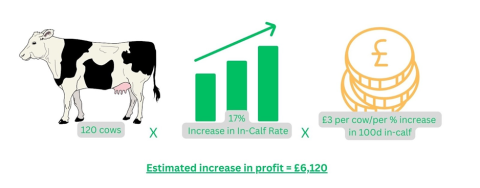
Components of Economic Benefit:
- Increased Milk Production: More cows calving earlier results in more days in milk.
- Reduced Empty Cow Costs: Fewer cows not in-calf reduces losses associated with non-productive animals.
- Improved Feed Efficiency: Adjusting concentrate feed based on body condition scoring optimizes feed costs.
- Greater Flexibility for Voluntary Culling: Improved fertility allows for better herd management decisions.
In addition, Frances has also been body condition scoring the cows more frequently to ensure cows are dried off and calving down in the optimum condition. If they were above target condition, a blue tape was applied to reduce the amount of parlour feed offered.
- As a result, 12 cows were put on a diet with half the amount of concentrate fed (6kg less compound feed per day) for 100 days, which amounted to 600kg less concentrate per cow. Therefore 7.2tonnes of parlour compound at £250/tonne amounts to £1800 less concentrate fed.
- Additionally, cows in appropriate condition at calving have a significantly lower disease risk which is associated with higher production, improved fertility and less treatments. Cases of milk fever have dropped from 8 to 2 in the year.
- Although Frances had never previously confirmed sub clinical ketosis; by using the ketone tester, they have given glucose boluses/propylene glycol to cows with sub-clinical ketosis and potentially prevented further problems. There have also been no cases of Left Displaced Abomasum (LDA), compared to the usual couple every year.
How to apply on your farm
- Undertake a consultation with an advisor such as your vet. Identify Gaps & Goals.
- Choose a few meaningful KPIs to monitor - the fewer and the more “downstream*” they are better.
Why not consider bolting this advice on when undertaking your health plan review for farm assurance? - Pick a couple of easy ideas and implement them – even if it is just starting to record data about the KPIs you have chosen to improve without any management changes initially.
- Assess progress after 3-6 months – what are the KPIs doing? What is working? What is necessary? What is possible? Can or should any new ideas be implemented?
- After 9-12 months, review KPI’s.
- Repeat this process annually.