

Gwern y Go maize trial final update
Key results
- Applying QLF L-CBF BOOSTtm and Corteva Instinct product to a maize crop was associated with an increase in yield of 2.5 tonne/ha
- Applying the products resulted in a Return on Investment of 170%
- Guided heat maps from the forage harvester can help optimise nutrient management planning for the future
- Portabello maize variety grew significantly more tonnage per hectare than the other varieties on the farm (Note: Field differences could have affected the results)
Background
A total of 40 hectares (98 acres) of maize was grown at Gwern y Go in 2025, the majority was ‘Pioneer 7179’ variety with 12 acres of ‘Portabello’ variety and 12 acres of ‘Debalto’ variety, with all the crop harvested and sold to a local digester plant.
The trial at Gwern y Go compared if ‘L-CBF BOOSTtm’, a liquid carbon fertiliser which feeds soil microbes and increases the availability of key nutrients, and “Instinct” a nitrogen stabiliser and nitrification inhibitor product that retains nitrogen in the soil for longer, would increase yield potential of the crop. Other potential benefits include minimising nitrogen losses to water and nitrous oxide to the air.
Purpose of the work
- To identify if applying QLF L-CBF BOOSTtm and Corteva Instinct product increased the crop yield
- To work out the return on investment of applying the products
What was done
All fields were soil sampled using a broad-spectrum test for nutrient management planning completed by the agronomist Juliet Anderson. The ‘Instinct’ and QLF Boost products were applied across all of the fields except two, where one received no product and was classified as the control and the other was split into two to provide a control and treatment plot.
- QLF boost product was applied during pre-emergence spraying at a rate of 10L/ha
- The Instinct by corteva product was applied at post-emergence spraying at a rate of 30L/ha
- So, no additional passes were needed or costs incurred to apply both products during the trial
Trial outcomes were based on crop yield at harvest, with trailers carting the crop weighed on a weigh bridge and DM samples taken when arriving at the biodigester plant
Outcomes
Table 1. Total tonnage and tonne/ha grown on the trial
| Untreated | Treated |
Total Tonnage | 85,530 | 94,280 |
Tonne / Ha | 27.2 | 29.9 |
- There was an increase of 2.476 tonne/ha fresh weight of maize grown per hectare on the fields where the products were applied
- This resulted in a calculated Return On Investment of 170% for the farmer based on the £/tonne Gwern y Go received for their maize in 2025 minus the cost of the products.

Figure 1. The maize crop in mid-August 2025- treatment on the left and control on the right of the picture
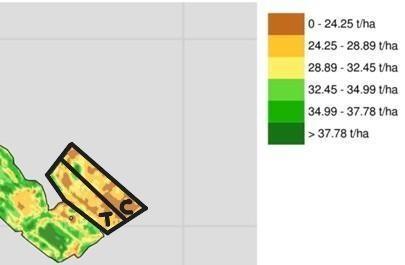
Figure 2. Yield heat maps of the trial field where ‘T’ is the Treatment area and ‘C’ is the Control
Table 2. Yield per hectare from the different maize varieties grown in 2025
| Field | Variety | Tonne/ha |
| 1 | Pioneer P7179 | 27.48 |
| 2 | Pioneer P7179 | 45.44 |
| 3 | Pioneer P7179 | 38.15 |
| 4 | Pioneer P7179 | 37.69 |
| 5 | KWS Debalto | 23.43 |
| 6 | KWS Portabello | 58.81 |
The Portabello maize variety grew considerably more tonnage per hectare than the other varieties on the farm in 2025, but the more favourable field conditions could have been the determining factor that affected the results. There is future opportunity for more work to be done at Gwern y Go to identify what variety best suits their soil type, climate and environment.