

Over seeding using livestock - Final Report
Key results:
- Considering the multi-year longevity of the leys, overseeding using livestock offers a cost saving of between £77.44/ha to £127.44/ha in comparison to ploughing.
- Overseeding was significantly more effective when sown onto post-grazed pasture compared to pre-grazed pasture.
- There was a significant difference in the species which were successfully established in this system.
- Using a biological seed treatment and sowing into post-grazing covers led to a 76% increase in species successfully established compared to sowing non-treated seeds into post-grazing covers.
Background:
Inspired by Farming Connect's Prosper from Pasture program and guidance from Precision Grazing, Wil and Nia have streamlined operations at Hendreseifion by moving to using contractors rather than owning expensive machinery and replacing the suckler herd with contract-reared heifers on the home block, supported by investments in grazing infrastructure.
Following his ethos of a low input pasture-based operation, Wil applied for the Try-Out Fund in order to trial a low-cost, low-disturbance method to improve the nutritional quality of his pastures.
Purpose of the work:
The project aims to establish whether permanent pastures can be over-sown successfully with a multi-species seed mix using a low-cost method involving little-to-no mechanical and chemical inputs, involving;
- Broadcasting grass, legumes, and herbs onto permanent pasture using an ATV-mounted electro-broadcaster, avoiding tillage.
- comparing the timing of seed introduction
- broadcasting the seed into pre-graze covers of between 1900 and 2500 kg DM/ha
- broadcasting seed into post -graze covers of 1200 - 1400 kg DM/ha
- trialling the use of a biological seed treatment
● Using livestock to trample the seeds for soil contact, replacing mechanical consolidation
● Evaluating establishment success based on botanical composition surveys prior to the second grazing event post-establishment.
- comparing the timing of seed introduction
What we did:
Three ~2ha - 3ha square fields were used in the trial, with ‘treatments’ replicated in each field. Each field split into four sub-plots to accommodate the four treatment variations;
Plots A1, B1 and C1 | Plots A2, B2 and C2 | Plots A3, B3 and C3 | Plots A4, B4 and C4 |
Seeds broadcast into pre-grazing covers (1900-2500 kg DM/ha) | Seeds broadcast into post-grazing covers (1200-1400 kg DM/ha) | Seeds broadcast into pre-grazing covers (1900-2500 kg DM/ha) | |
Seeds coated with biological seed treatment (Treated seeds) at 0.8L product per 100kg seeds (diluted with 2.4L water | Seeds not treated (Un-treated seeds) | ||
Figure 1. The treatments applied across the 4 sub-plots
Seed rate for each plot was 10 kg/acre (25 kg/ha) and included the following:
| ||
Grass: 37% Perennial ryegrass 9.5% Festulolium 6% Timothy
| Legumes: 11.5% Red clover 11% White clover 2.5% Alsike clover 2% Birdsfoot trefoil
| Herbs: 10% Plantain 5% Chicory 2.5% Burnet 2.5% Sheep's parsley 0.5% Yarrow
|
For the preparation and establishment (March - September 2025) the following actions were undertaken:
Initial preparation
Trial field assessment and planning surveys were conducted in March 2025 to select and prepare the trial fields. VESS and visual surveys were completed to assess soil structure, identify existing species, and determine the sward's openness and thatch presence.
A limiting clay layer was found at 7cm depth. Soil analysis confirmed suitable phosphorus (P2) and potassium (K2-) levels. Only 60kg/ha of P and K was recommended for seed establishment, delivered via an application of 0.24.24 at a rate of 250 kg/ha, with the small surplus of P supplied netted against the future requirement of the crop. Two of the 3 fields were at the target pH of 6.3 - 6.5 while field C fell short at pH 6. Applying Calcifert was recommended at a rate of 247 kg/ha. Enough to raise the pH to above 6.3 in medium soils.
The survey data captured informed seed selection.
➔ Perennial ryegrass was observed, confirming suitability for oversowing.
➔ Biological seed treatment selected for trial due to presence of competitive grasses in existing pasture.
➔ The presence of a limiting layer led to the inclusion of deep-rooting species like Chicory and Plantain to penetrate the soil and increase soil organic matter (SOM).
➔ A high rate of clover was added to the seed mix due to its low presence in the fields, enhancing protein and nitrogen fixation.
➔ The open sward and lack of thatch allowed for longer-term grasses to be selected.
Pre-sowing
- To maximise chances for success, LoRaWAN sensors to monitor soil temperature and moisture (as seen in figure 2) were used and seed treatment added to the trial.
- Sub-plots were set-up and electric fences for grazing management.
- A decision was made on 30 April to delay sowing due to dry conditions and soil moisture content dropping 3% per day.
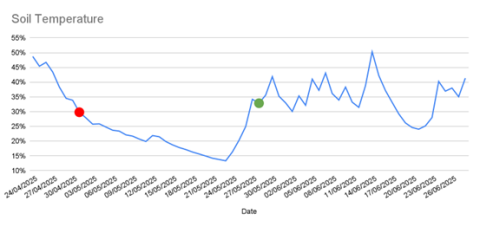
Figure 2. Top 7.5cm soil moisture content in % between 24 April and 28 June. The red dot indicates when the decision was made to delay the sowing event. The green dot indicates when the first plot was sown
Sowing and post-sowing management
- Seed was treated day before planned sowing date (adverse weather conditions delayed sowing of first plots by 48 hours)
- The plots were sown in the following order:
Sowing into pre-grazing covers
- Broadcast seed.
- Cattle introduced to plot at a rate of 137 per ha or 35,600 kg Liveweight per ha, using temporary electric fences to ensure existing pasture was grazed down to 1400 kg DM/ha in 6 hours or less.
- Livestock was then removed.
Sowing into post-grazing covers
- Cattle introduced to plot at a rate of 137 per ha or 35,600 kg liveweight per ha, using temporary electric fences to ensure existing pasture was grazed down to 1400 kg DM/ha in 6 hours or less.
- Broadcast seed.
- Cattle were kept in the plot for 1 hour to trample in seeds.
- Livestock was then removed
All plots
- Post-sowing competition control - Ideally, the plots would be grazed by low demand livestock 5 days post sowing, however no dry-stock were available at the time, so this step was skipped for all trial plots.
- Instead, plots were grazed lightly using young cattle, 8 - 10 weeks post-sowing.
- Botanical composition surveys were conducted and samples taken for nutritional analysis 30 days after light grazing
Outcomes:
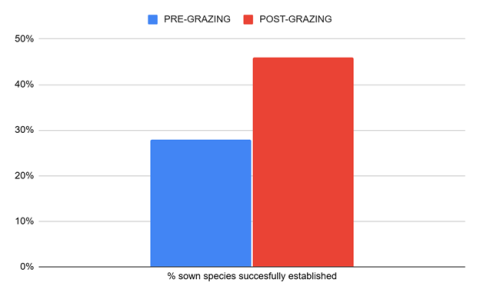
Figure 3. Average percentage of sown species present across all plots, sowing into pre-grazing covers compared with sowing into post-grazing covers.
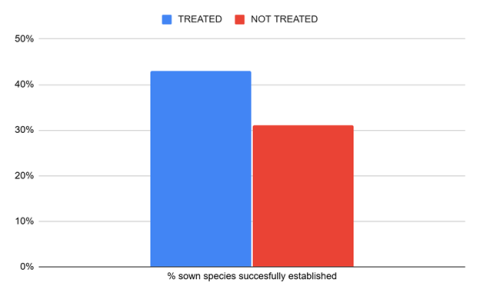
Figure 4. Average percentage of sown species present across all plots, treated seeds compared with non-treated seeds.
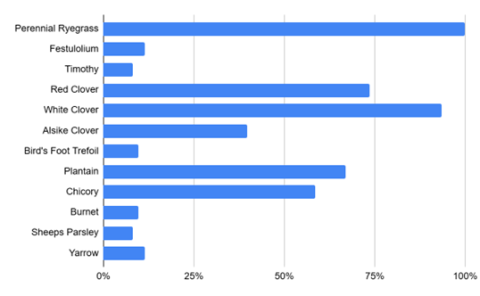
Figure 5. Percentage of all quadrat surveys, across all plots the sown species were identified in. (e.g. 100% = present in all 60 quadrat surveys conducted on 3 September)
Return on Investment
Table 1. Return on Investment (ROI) for the most successful method used at Hendreseifion (treated seeds broadcast into post-grazing covers) compared with the same method, but with hypothetical soil health correction costs factored in. Also compared are two full reseed methods trialled by another Farming Connect Our farms project at Cilywinllan, using data from the control plots at Hendreseifion as the baseline (Control). AHDB value of forage calculator was used to calculate value of forage, based on wet chemistry nutritional analysis, plate meter readings and survey data.
Benchmarking | |||||
Cilywinllan project ploughed | Cilywinllan project Glyphosate and direct drilled | Control (permanent pasture) | Hendreseifion Electrobradcast + Livestock | Electrobroadcast + Livestock + raise pH, P and K levels | |
| Total Cost of establishment £/ha | £709.74 | £610.89 | 0 | £200.00 | £400.00 |
| Predicted forage growth T DM/ha per year | 12.00 | 9.00 | 6.50 | 8.60 | 8.60 |
| Total Value of forage £/ha per year | £1,719.30 | £1,289.47 | £802.30 | £1,179.14 | £1,179.14 |
| value of additional forage grown compared to control £/ha per year | £917.00 | £487.17 | 0 | £376.84 | £376.84 |
| ROI after 1 year | 29.20% | -20.25% | 88.42% | -5.79% | |
| ROI after 2 years | 158.40% | 59.50% | 276.84% | 88.42% | |
| ROI after 3 years | 287.60% | 139.24% | 465.25% | 182.63% | |
| ROI after 4 years | 416.81% | 218.99% | 653.67% | 276.84% | |
Based on the longevity of the leys, overseeding using livestock presents a notable cost saving ranging from £77.44/ha to £127.44/ha when compared to the cost of ploughing. Furthermore, the timing of the intervention is critical, as overseeding was found to be significantly more effective when applied to post-grazed pasture rather than pre-grazed pasture. This difference in application timing, alongside other factors, resulted in a significant variation in the species successfully established within the system. Notably, combining a biological seed treatment with sowing into post-grazing covers led to a substantial 76% increase in successful species establishment compared to sowing non-treated seeds into the same post-grazing covers
How to apply on your farm:
Correct soil environment and prepare the existing sward: Test and assess soil conditions and evaluate content of existing ley before deciding on the overseeding method and whether a full reseed is more suitable. Prioritise pre-establishment soil health corrections, aiming for a target pH of around 6.3, with P and K indexes at 2. Before seeding, apply high-impact grazing using electric fences to reduce the existing sward cover to a maximum of 1400 kg DM/ha to minimise competition.
Strategic seed mixture design and treatment: Utilise the Multi-Species swards seed mix calculator to plan the exact composition, focusing on quick-establishing species suitable for the local climate and grazing pressure. Consider using a biological seed treatment to enhance germination vigour and resilience against competitive pressures from the existing ley
Precision timing using real-time data: Establish the optimal overseeding window by combining long-range weather forecasts with real-time soil and environmental conditions gathered via LoRaWAN sensors (monitoring soil temperature and moisture) to ensure the best possible environment for seed-to-soil contact and initial seedling growth.
Application and seed incorporation method: Broadcast the prepared seed mixture directly onto the tightly grazed sward. Immediately follow broadcasting by utilising livestock (hoof trampling) to push the seed into the soil surface, ensuring critical seed-to-soil contact without requiring mechanical cultivation.
Aggressive post-sowing competition control: Implement a temporary competitive grazing measure by bringing low-demand, mature stock (e.g. dry ewes or non-lactating cattle) back to the field 5 days post-seeding to re-graze the existing pasture and reduce competition; this stock must be removed before the new seedlings emerge. Plan the long-term grazing regime to ensure the persistence of the forbes and legumes to maximise the return on investment (ROI).
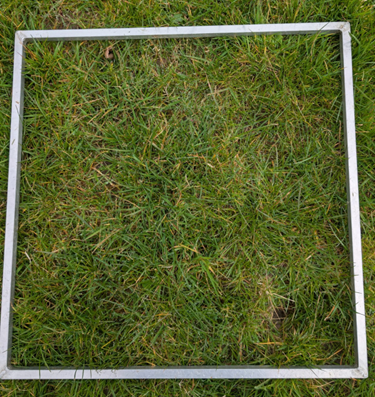
Image 1. Photo of quadrat collected via Senus Terrain app during initial surveys of plot A2 on 27 March 2025
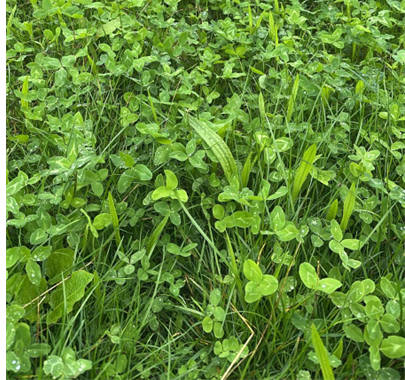
Image 2. Plot A2 on 3 September 2025
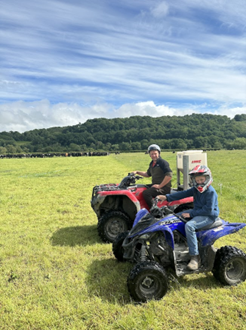
Image 3. Wil and his son, ready to broadcast seed into post-grazing covers