

Low input grazing leys - Final Report
Key results:
- Reseeding benefit: All reseeded plots grew at least 50% more forage than the control group in 2025.
- Drought resilience: The multispecies mixture outperformed the diverse grass and white clover mix and standard ryegrass and clover mix in the drier conditions of 2025.
- Forage quality: There were no negative impacts on forage quality observed by selecting more diverse seed mixtures compared to standard mixes.
- Establishment challenges: Repeated sward assessments failed to identify significant levels of tall fescue, meadow fescue, or festulolium in the diverse mixtures, even in early stages.
Background:
Recent years at Brynllech Uchaf have seen successful improvements to the farm's better land, specifically through the introduction of high-quality red clover leys. To optimise management across the entire holding, attention has now shifted to improving poorer grazing fields.
Existing leys in these areas are struggling with changing weather patterns, particularly hotter, drier summers. Over the last two years, poor growth has left these fields ungrazed for long periods, placing unsustainable pressure on the farm’s best improved blocks. This project aims to identify seed mixtures that suit these typical Meirionnydd hill conditions, thriving under a low-nitrogen system while offering resilience against future climate challenges.
Purpose of the work:
The primary objective of this project is to identify seed mixtures that are best suited to the farm's marginal fields, low-input system, and specific climatic conditions. The work focuses on:
- Evaluating drought resilience: Assessing how different mixtures perform under limited soil moisture, specifically comparing their growth stability against conventional ryegrass leys during prolonged dry spells.
- Optimising forage production: Improving both the quantity and quality of homegrown forage to expand grazing availability during peak summer demand. This strategy allows high-quality leys elsewhere to be rested, enhancing overall farm resource efficiency.
- Benchmarking sward types: Comparing the performance of diverse grass leys, multispecies leys, and perennial ryegrass (PRG) & white clover against existing permanent pasture to determine their potential for increasing dry matter production and crude protein content.
What we did:
The trial was established at Brynllech Uchaf to evaluate the performance of diverse swards against standard industry mixes and permanent pasture. A randomised plot system was implemented, testing four distinct variables: a Multispecies mixture, a diverse grass and white clover mix (designed for resilience), a standard ryegrass and clover mix, and a Control plot of existing permanent pasture.
To ensure fair comparison, all three reseeded plots received an application of 50kg of Nitrogen per hectare late in Spring 2025, while the control plot received none, mimicking a low-input baseline versus a reseeded scenario.
Over a two-year period (2024 and 2025), sward performance was monitored rigorously. This involved measuring whole-season grass production through four specific cuts each year (May, June, August, and October). Additionally, repeated botanical surveys—using both visual assessment and hand separation techniques—were conducted to track the persistence of specific sown species and forage quality was analysed to detect any nutritional penalties from increased diversity.
Outcomes:
The trial generated significant data regarding yield, resilience, and sward composition over the two-year period.
Total forage yield and reseeding benefit: The most immediate finding was the substantial benefit of reseeding combined with fertiliser application. All three reseeded plots produced more biomass—at least 50% more—than the un-reseeded control plot (Figure 1). While the control received no fertiliser, the gap emphasises the immense potential of sward rejuvenation. Among the reseeded plots, performance was relatively consistent, though the Multispecies mixture showed a slight overall yield advantage.
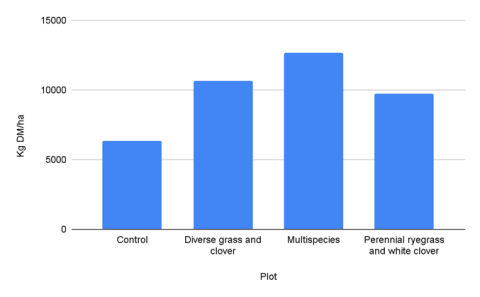
Figure 1. Total average forage herbage biomass growth (Kg DM / ha) from May 2025 to October 2025 for all trial plots
Drought resilience (2024 vs. 2025):
The trial specifically aimed to test performance under water stress. 2025 proved to be a drier year than 2024, providing excellent comparative conditions.
- 2024 Performance: In the wetter year, the diverse grass and white clover mix was the top performer.
- 2025 Performance: All plots grew more herbage in the drier conditions of 2025 than in 2024, but the Multispecies mixture provided the greatest benefit, outperforming the others. This confirms that species diversity offers a "buffer" against moisture deficits, maintaining growth when standard leys might slow down as demonstrated in Figure 2.
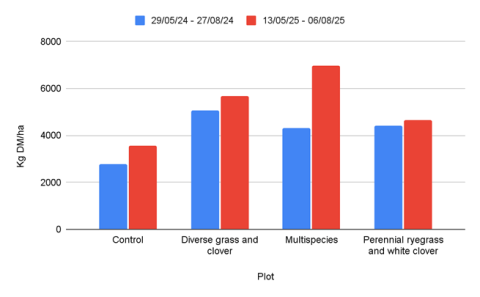
Figure 2. Average forage herbage biomass growth (Kg DM / ha) during Summer 2024 and 2025
Forage quality:
A common concern with diverse swards is a potential drop in nutritional value compared to pure Ryegrass leys. The results showed no consistent trends indicating this; including a wider variety of grass species had no negative impact on forage quality. However, it was noted that standard NIR (Near-Infrared Spectroscopy) analysis might struggle to accurately assess diverse swards, suggesting wet chemistry is safer for future trials.
Species establishment:
Despite the yield success, establishing specific complex grasses proved difficult. Repeated assessments failed to identify significant levels of tall fescue, meadow fescue, or festulolium, even early on. Furthermore, Clover levels remained low (<10%) in the diverse mixes, whereas they reached 10-20% in the standard ryegrass and clover mix. This suggests that while the concept of diversity works for yield, the specific establishment of these competitive species requires refined management.
Return on Investment
Table 1 showcases the Return on Investment (ROI) of all 3 reseeded plots compared with the permanent pasture, control plot. The cost of an application of 50kg/ha of N each year for the three reseeded plots compared with no N applications for the control plot factored in, based on the May 2025 price for Ammonium Nitrate of £380 per tonne.
Table 1. Return on Investment
Benchmarking | ||||
| Control - permanent pasture | Diverse grass and clover | Multispecies | Perennial ryegrass and white clover |
Total Cost of establishment £/ha |
| £817.59 | £813.76 | £795.36 |
Additional input costs £/ha |
| £55.07 | £55.07 | £55.07 |
Forage growth T DM/ha between May and October 2025 | 6.33 | 10.67 | 12.68 | 9.74 |
Total Value (per ha) of forage grown between May and October 2025 | £780.27 | £1,307.47 | £1,556.37 | £1,181.73 |
Value of additional forage grown compared to control |
| £527.21 | £776.11 | £401.46 |
ROI after 1 year |
| -42.25% | -11.39% | -56.45% |
ROI after 2 years |
| 15.49% | 77.21% | -12.90% |
ROI after 3 years |
| 73.24% | 165.82% | 30.66% |
ROI after 4 years |
| 130.99% | 254.42% | 74.21% |
*AHDB value of forage calculator was used to calculate value of forage, based on NIRS nutritional analysis and cut and weigh data from May 2025 to October 2025
The benchmarking data reveals that the Multispecies mix is the most financially viable option based on 2025 data. It yields the highest forage growth (12.68 T DM/ha) and total value (£1,556.37/ha), generating nearly double the output of the control pasture.
While all reseeding options fail to return the initial investment (establishment costs; £795-£818/ha), the multispecies mix recovers fastest, achieving 77.21% ROI by Year 2 and a substantial 254.42% by Year 4.
Conversely, the perennial ryegrass and white clover mix offer the lowest return among the mixtures trialled, taking three years to turn a profit. The diverse grass and white clover mix serves as a solid middle-ground performer. All three seed mixtures demonstrate a strong ROI through increased feed availability during critical pinch points
How to apply on your farm:
- Assess your drought risk first: If the farm suffers from reduced growth during dry summers, prioritise multispecies mixtures. The data confirms they offer superior resilience and growth in drier years (like 2025) compared to standard mixes.
- Don't fear quality loss: Farms can confidently move away from pure ryegrass leys without sacrificing feed quality, in low input systems. The trial showed no negative impact on forage quality when using diverse mixtures, allowing for resilience gains without lost performance.
- Support fertility to see results: The trial showed a 50% yield increase in treated plots which received 50kg of Nitrogen. Reseeding alone isn't enough; ensure the new ley is supported with adequate nutrition (N, P, K, and Lime) to realise its potential.
- Manage establishment carefully: Complex grasses (Fescues/Festuloliums) are harder to establish than ryegrass. If using them, ensure seed-to-soil contact is perfect and competition is managed aggressively, as these species struggled to establish significant