
13 March 2026
Iwan Davies and his parents, Brian and Nicky, became new entrant farmers in 2013 when they took on the tenancy of 66-hectare (ha) Meity Isaf near Trecastle, Powys.
Iwan, now 28 and the youngest of Brian and Nicky’s three children, wanted to farm and that opportunity came when they secured a 10-year Farm Business Tenancy, which has since been renewed.
Brian, who grew up on a farm, has continued to work as a construction foreman and Nicky has a part-time job as a personal assistant while Iwan is farming full time.
The renewal of the FBT agreement gave Davies’s confidence and stability to invest in the business, including improving the flock of mostly Brecknock Hill Cheviot.
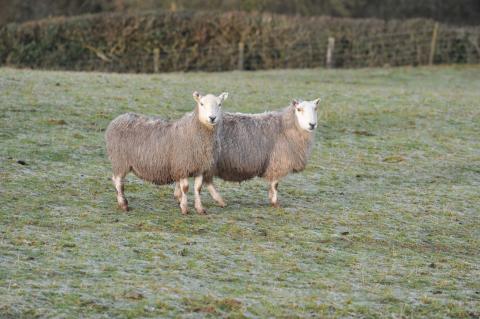
The family took on the farm’s flock of 450 ewes and 120 replacements with the tenancy, maintaining that number and introducing a small number of Welsh Mule-crosses by tupping four-year-old ewes with a Bluefaced Leicester ram.
In 2023, the business successfully applied to join the Farming Connect Welsh Sheep Genetics Programme (WSGP) to utilise performance recording to genetically improve the flock.
Estimated Breeding Values (EBVs) are now being used to improve selected traits, including litter size and lamb growth rates, and ewes that can better maintain body condition.
The end goal is to breed the best performing ewe for the system, says Iwan.
“As tenant farmers we must do everything we can to be as efficient and profitable as possible, and for us that includes using the tools of performance recording to find an animal that is the right match for the farm’s environment and how we farm - once you have those genetics in the flock they are there.’’
“If your lambs finish off grass quicker and at better weights then it stands to reason that they will be more profitable.’’
The flock is largely made up of ewes with indexes in the top 10% for their breed, based on performance.
After just two lambing seasons marginal gains have already been achieved through performance recording with a 0.2kg uplift in eight-week lamb weights and a 4% improvement in lamb survival rates - the lamb survival index has increased from 0.18 to 0.22 since becoming a part of the WSGP.
In 2025, the higher index ewes in the flock weaned an average of 4.2 kg more lamb than the lower index ewes.
One of the biggest wins has been an opportunity to sell lambs at a price premium as a proportion of their sales to Dunbia are now eligible for a 30p/kg price uplift as a gold supplier to the Sainsburys Taste the Difference lamb scheme – around 70% of the Davies’ lambs qualify for that premium.
“For us that works out at an average of £6 a lamb,’’ says Iwan. “Performance recording helped us get onto the scheme because one of the criteria is using EBVs.’’
Providing key performance indicators (KPIs) is another requirement, he adds. “Performance recording provides us with all the data so all we have to do is pull our KPIs from those figures which makes everything easier.’’
Reducing cost of production is his principal goal from improving genetics. “That was one of the main reasons for joining the programme, to produce more from the same inputs as before.
“We have hill grazing rights so if we can produce a sheep that can do better on the hill, we will use less fertiliser and concentrate, all that means a cheaper cost of production.
“It is environmentally friendly too because if we are not spending on cake and feeding grass we can grow at home, our lamb is going to have a lower carbon footprint.”
Three hundred ewes were selected for recording and replacements have since been bred from these.
Progeny is EID tagged and DNA samples are taken from their ears at eight weeks of age. The analysis of the DNA is matched to that of the ewes and sires used, to allow parentage to be assigned.
Having those figures allows better breeding decisions to be made, providing the information Davies’s need to decide which rams and ewes produce the offspring most suited to Meity Isaf and the hill land.
They have invested in a performance recorded tup, purchased directly from a breeder, and it has paid off.
“When I drafted the ram lambs in 2025, I didn’t initially do that from my figures, I picked the nicest hill-type of lambs instead, but when I checked they were all progeny of that performance recorded ram,’’ says Iwan.
It is not just the data that illustrates the improvements, there is a visual difference too.
“Some of the ewes are holding their condition better and we can see that these are the higher index ewes because we have tagged them accordingly,’’ says Iwan.
Twin-bearing ewes are housed up to eight weeks before lambing, depending on weather conditions, and fed an 18% protein concentrate and hay.
Singles historically grazed turnips ahead of outdoor lambing but this year they are on 2.8ha of rape and Italian ryegrass as this will provide spring grazing too.
Some of the early-born lambs are creep fed to accelerate finishing from mid-June to support cashflow, but the majority are finished off grass. A strong store price in 2025 saw the tailenders sold through that market.
Iwan says there are no downsides to recording but the time and labor requirement can be a challenge.
“Fitting it into an already busy day can be a bit of a struggle and also getting up to speed with it all.’’
Ahead of recording, a Farming Connect study tour in Scotland enabled him to understand how other hill sheep farmers utilised this system, and a training day too.
While every farm is different, Iwan says for him there have been definite benefits in recording because it has given him a better understanding of his flock and how it’s performing.
“It stops us from getting sidetracked because we are forced to keep up to date with data - that accountability makes you keep on top of it,’’ he says.
“All strong businesses rely on solid foundations, and our ewe flock underpins the performance and value of every lamb born.’’
Flocks participating in the Welsh Sheep Genetics programme have benefitted from financial support for data collection, advice and guidance on setting achievable targets for flock improvements, opportunities to improve knowledge and understanding of different topics impacting genetic progress, and an opportunity to be involved in innovative research projects.
Each flock has a breeding action plan and they also receive an annual review of their flock’s performance.
This allows farmers the opportunity to review how their ewes are performing, says Gwawr Williams, Head of Sheep Genetics at Mentera, which delivers Farming Connect on behalf of the Welsh Government.
Farmers are increasingly realising the benefits of improving their flock through genetics, whether by full performance recording the flock, or purchasing stock rams with EBVs, she says.
“By gathering initial KPIs and information on participating flocks for the breeding action plan we were able to identify areas for improvement genetically.
“The annual reviews then allow farmers to see the progress in their flock’s performance, and also detailed information on each individual animal – which allows them to make justified breeding decisions and focus on key traits they wish to improve within their own flock.’’
FARM FACTS
Land rising from 1,000m – 1,400m
Grazing rights on Great Forest for 600 ewes
Replacement ewes winter tacked in Pembrokeshire
110% average flock scanning percentage
17-19kg average deadweight, at most R3L
Small number of Hereford suckler cows and pigs
‘Meity Isaf’ boxed beef and pork sold direct to consumers