

The role of foliar feeds and tissue diagnostics for improving maize nutritional quality: Final Update
Key results:
- The treated plot yielded 14.6t/acre more than the untreated plot, with a dry matter of 41.4% compared to the untreated plot of 37.8%.
- The silage from the treated plot had a D-value of 72% compared to the untreated plot at 53%.
- The ME of the treated plot was also higher at 11.80 MJ/kg compared to the untreated plot at 8.60MJ/kg.
Background:
The Bowyer family aims to maximise home-grown forage to reduce their reliance on bought-in feeds for their crossbred ewes and weanling cattle. Given the rising production costs for farmers, maximising yield and quality from crops is crucial. This trial specifically investigated whether foliar feeds, used to address identified maize crop deficiencies, could enhance nutrient levels, leading to increased yields and improved feeding quality.
Purpose of the work:
The aims of the project were to:-
- Address nutrient deficiencies during the growing season with foliar applications of nutrients.
- Investigate whether applying foliar feeds to enhance nutrient levels in maize could lead to increased yield and improve feed quality.
What we did:
Initial setup and first treatment
- Pre-planting: The field was initially soil tested to establish baseline nutrient levels.
- Planting: Maize variety 'Portabello' was planted on 10 May.
- First tissue sampling: The field was tissue sampled on 9 June, when the crop had reached the 4 true leaves stage, to identify any early nutrient deficiencies.
- First application: Following results that indicated low magnesium levels, the majority of the field was sprayed with a foliar fertiliser containing Nitrogen, Phosphate, Potash, Sulphur, Magnesium, Manganese, Copper, Zinc, Boron, Iron, and Molybdenum (Yaravita CROPLIFT Pro) at a rate of 5kg/ha. An untreated strip was deliberately left as the control plot.
Second treatment and Harvest
- Second tissue sampling: The crop was tissue tested again just over two weeks after the first application.
- Second application (7 July): Based on the second set of tissue tests, a second, more specific foliar application was made to the treated plot:
- Efficient N (a foliar nitrogen product) was applied at 20L/ha.
- Mancozin (containing manganese and zinc) was applied at 1.25L/ha.
- Epsotop (a magnesium sulphate product) was applied at 5kg/ha.
- Final diagnostics: Further tissue tests were conducted a few weeks later.
- Harvest: The plots were harvested on 13 September, and a silage sample was immediately sent for analysis.
Outcomes:
The initial soil analysis (Table 1) showed the pH and the Phosphate index was within target, favouring nutrient availability. However, several potential limitations were identified including low levels of Potassium and Sulphur. Crucially, Boron was low, a deficiency that can negatively impact maize reproduction and lead to small cobs with missing kernels. Molybdenum and Sodium were also low, but these deficiencies were not expected to cause problems for the crop.
Table 1. Soil analysis for field prior to planting.
Analysis | Result | Guideline | Interpretation |
| pH | 7.2 | 6.5 | Normal |
| Phosphorus (ppm) | 23 | 16 | Normal |
| Potassium (ppm) | 62 | 121 | Low |
| Magnesium (ppm) | 82 | 50 | Normal |
| Calcium (ppm) | 2142 | 1600 | Normal |
| Sulphur (ppm) | 3 | 10 | Very Low |
| Manganese (ppm) | 88 | 80 | Normal |
| Copper (ppm) | 5.3 | 4.1 | Normal |
| Boron (ppm) | 0.92 | 1.60 | Low |
| Zinc (ppm) | 8.8 | 4.1 | Normal |
| Molybdenum (ppm) | 0.01 | 0.30 | Very Low |
| Iron (ppm) | 1020 | 50 | Normal |
| Sodium (ppm) | 22 | 90 | Very Low |
| C.E.C (meq/100g) | 12.1 | 15.0 | Slightly Low |
Following planting, the maize crop immediately suffered due to very dry weather, leading to slow growth and a distinct yellow colour. Concerned by the visual symptoms, Ty Coch initiated a tissue test, which, despite the poor appearance, showed surprisingly adequate nutrient levels aside from being low in magnesium and boron. Identifying the dry weather as the cause of poor nutrient uptake, Ty Coch chose to apply Yaravita CROPLIFT Pro to boost the crop. The crop's response to this initial foliar application was then assessed by conducting a second tissue test just over two weeks later.
The tissue analysis (Table 2) conducted after the initial treatment confirmed the crop was still low in all macronutrients (Nitrogen, Phosphorus, and Potassium) , a situation attributed to the sustained dry weather and rapid growth which hampered nutrient extraction from the soil. Of particular concern, Magnesium remained very low and was prioritised for treatment, as its deficiency causes yellowing between the leaf veins and can lead to leaf death. Manganese was also very low and prioritised, with deficiency resulting in interveinal chlorosis and stunted plant height. Since Calcium was very low but not a priority, and Zinc was slightly low, the decision was made to apply a targeted foliar mix providing all the very low and priority nutrients.
Table 2. Analysis Results (LEAF) – End of June
Analysis | Result | Guideline | Interpretation |
| Nitrogen (%) | 2.94 | 3.50 | Slightly Low |
| Phosphorus (%) | 0.26 | 0.35 | Slightly Low |
| Potassium (%) | 2.97 | 3.00 | Slightly Low |
| Calcium (%) | 0.14 | 0.30 | Very Low |
| Magnesium (%) | 0.10 | 0.25 | Very Low |
| Sulphur (%) | 0.14 | 0.10 | Normal |
| Boron (ppm) | 4.1 | 7.0 | Low |
| Copper (ppm) | 4.5 | 7.0 | Low |
| Iron (ppm) | 80 | 75 | Normal |
| Manganese (ppm) | 18.7 | 40.0 | Very Low |
| Molybdenum (ppm) | 0.59 | 0.20 | High |
| Zinc (ppm) | 23.6 | 30.0 | Slightly Low |
The final tissue analysis (Table 3) revealed that there was not a considerable difference in nutrient levels between the treated and untreated plots. There were, however, subtle differences, such as the treated crops Nitrogen levels being only slightly below the guideline, while the untreated crops were very low. Surprisingly, levels of key nutrients like Magnesium, Manganese, and Zinc were up to guideline levels in both plots, suggesting the untreated plot had improved its uptake. This unexpected result is hypothesised to be due to a small amount of rain in August and the deeper root growth of the maturing plants, which would have improved the plant's ability to scavenge nutrients from the soil.
Table 3. Final Analysis (LEAF) for treated and untreated plot.
Analysis | Treated plot | Untreated plot |
| Nitrogen (%) | 3.30 | 1.95 |
| Phosphorus (%) | 0.28 | 0.18 |
| Potassium (%) | 1.35 | 1.39 |
| Calcium (%) | 0.80 | 0.63 |
| Magnesium (%) | 0.29 | 0.25 |
| Sulphur (%) | 0.22 | 0.13 |
| Boron (ppm) | 25.2 | 10.6 |
| Copper (ppm) | 15.3 | 8.6 |
| Iron (ppm) | 109 | 80 |
| Manganese (ppm) | 61.2 | 68.6 |
| Molybdenum (ppm) | 0.78 | 0.83 |
| Zinc (ppm) | 51.1 | 36.8 |
High | Normal | Slightly Low | Low | Very Low |
Despite the subtle tissue results, the final harvest data showed a vast difference in performance (Table 4), with the treated plot yielding 14.6t/acre more and having a higher dry matter of 41.4% compared to the untreated plot's 37.8%.
Table 4. Yield and Dry Matter of treated and untreated plot.
| Yield (tonnes per acre) | Dry Matter (%) |
Treated | 23.8 | 41.4 |
Untreated | 9.2 | 37.8 |
The visual difference at harvest clearly supported the yield data: the untreated plot was distinctly brown and dead (Figure 2), while the treated plot remained green (Figure 1).
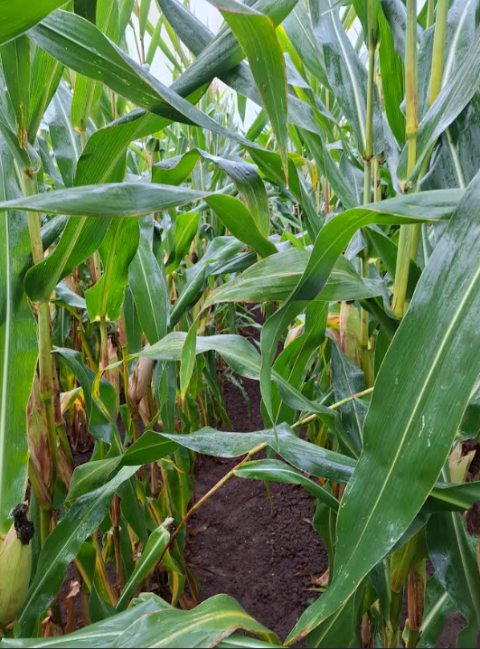
Figure 1. Treated plot at harvesting.
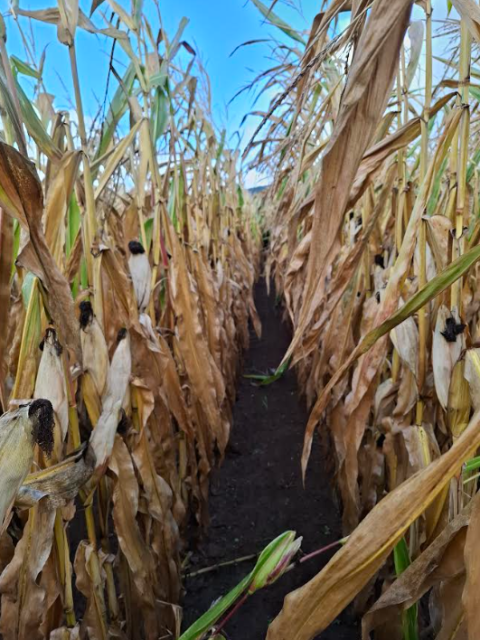
Figure 2. Untreated plot at harvesting .
The final analysis confirmed the success of the treatment in improving forage quality, with the treated plot showing a D-Value (Digestibility) of 72% compared to 53% for the untreated plot, and a significantly higher Metabolisable Energy (ME) of 11.80MJ/kg compared to 8.60MJ/kg. Although differences were hard to observe during the growing season, potentially due to the dry weather, substantial differences were evident at harvest in yield and colour: the untreated plot died off much quicker. This strongly suggests the foliar nutrients kept the treated plot greener longer, enabling the significant increase in yield and quality. The farmer has noticed that in previous years the cattle have preferred the grass silage to the maize silage, however this year he has noticed that they have preferred the maize which could be due to the good silage results from the additional nutrients applied during the growing season.
How to apply on your farm:
- Soil sample for baseline fertility: Always conduct a soil analysis of the chosen field before planting to establish the baseline status of macronutrients and trace elements. Identifying deficiencies like low Potassium, Sulphur, or Boron pre-planting allows for initial corrective measures.
- Select suitable variety: Choose a maize variety that suits your specific system and local climate conditions.
- Use tissue diagnostics to guide treatment: Tissue test the maize crop at key growth stages (e.g 4 true leaves) to check for current nutrient deficiencies, which may not be apparent in the soil due to factors like dry weather impacting uptake. Treat the crop with targeted foliar applications of nutrients based directly on these diagnostic results.
- Target priority deficiencies: When deficiencies are identified, prioritise treatment based on nutrient severity and impact on the crop's yield potential, such as focusing on Magnesium, Manganese, and Zinc during key vegetative stages, as was done in this project.
- Regular visual crop inspection: Regularly inspect the crop visually to check for early signs of changes, pests, or disease. Visual symptoms, such as the yellowing observed in this project, should prompt immediate tissue testing to prevent yield loss.