

Treathro - Final Update
Key results:
The field which had no grazing (only by ponies) showed the least earth worm activity, but scored highest for soil structure via VESS assessment and carbon stock (top 10cm).
Background:
The project will look at different areas of the farm that have differing sward compositions and management to investigate the impact this has on the microbiology of the soil. It is important to understand that biodiversity is not just about what we can see above ground. There is a wealth of biodiversity living in the soil and the more biodiverse soils will be more resilient and functional. A healthy soil will then be able to support healthy ecosystems above ground which support biodiversity and productive farming systems.
Purpose of the work:
Compare the soil biology of different management practices, to include permanent pasture, areas of no grazing, silage fields and min till herbal leys. Investigate the impact of these management practices on soil compaction and visual assessment, soil microbiology, earthworm abundance, presence of insects and pollinator species (particularly dung beetles) and forage species composition.
What we did:
Soils from four different management practices were assessed for soil health in March. The four different management practices were:-
- rotational grazing permanent pasture,
- fields grazed by a couple of ponies only (cliff/coastal area dominated by bracken, heather and gorse),
- Ryegrass and white clover but also significant proportion of other grassland species and managed for haylage
- permanent pasture with herbal ley slot seeded into it
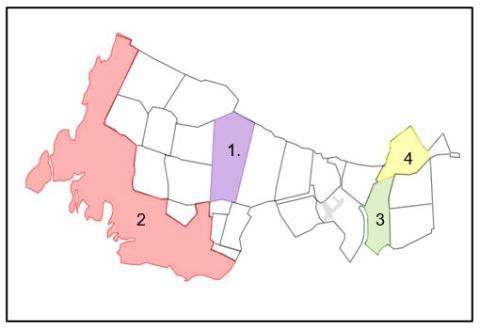
Figure 1. Treathro Farm map
The Welsh Soils Project sampling method was replicated for assessing the soil health, taking three samples from 0-50cm depths. In addition, a VESS assessment and earthworm survey was carried out at each plot. A VESS (Visual evaluation of soil structure) gives a score for soil structure and aims to be a simple in-field assessment that can be undertaken by the farmer. Three pits were dug across each of the three fields and a block of soil 20 x 20 x 20 cm was removed. If it was not possible to dig down to 20cm this was noted. In the three fields an assessment was also made by the hedge.
Details of how a VESS is carried out can be found in this guide - How to assess soil structure
A Plantlife species survey was done at the end of April by Shenna Duller and Brynony Jenkins to look at the habitat at Treathro and establish a full species list. In October, to follow up from the initial soil sampling carried out in the spring another VESS assessment and an earthworm survey was carried out at each plot.
Outcomes:
Soil Carbon stock
The average soil carbon stock (t/ha) of each sampling depth within each field and by the hedge can be seen in Table 1 below. Field 2 high carbon stocks in the top 10cm could be attributed to the bracken that breaks down at the end of every season.The soil here was very dry and crumbly despite high rainfall overnight prior to the assessment.
Table 1. Results from soil sampling in different fields at varying soil depths.
ND= no data, whereby it was not possible to obtain a representative soil sample.
Biodiversity Survey
The Plantlife Species survey (available on request) reported that Treathro supported a rich diversity of habitats and species. It found that the soils were generally in good condition with the Malvern series being the dominant soil type. The pH levels varied across the sites, indicating past lime applications in some areas. The survey identified a wide array of plant species on the farm, including various grasses, wildflowers, and ferns. The species composition differed between the fields and the clifftop SSSI, reflecting variations in soil conditions and management practices.
VESS
The VESS results for both assessments can be seen in table 2 and 3 below. Surface compaction was a feature in field 4. This is not surprising given the wet season and these fields are grazed by cattle. Some surface compaction was seen also in field 1 and 3, and the soils are relatively shallow, but despite this for the most part they were free draining. The establishment of herbal leys and the use of rotational grazing with long rest periods could really help the soil structure to recover and alleviate the surface compaction.
Table 2. VESS March 2024
Table 3. VESS October 2024
Soil Microbiology and earthworms
The soil microbiology and earthworms were assessed at Treathro. It was found that the levels of bacteria in the soil was very dominant and it would be good to see more fungi. It is important to remember that building soil health takes time and it may take several years before changes are seen.
20cm x 20cm x 20cm pits were dug to look at earthworm numbers in March 2024 and October 2024, Figure 2 shows the results. The worms were counted noting how many in total (juveniles and adults) and how many were adults and therefore capable of reproducing. The worms were categorised according to three different layers in the soil profile; Epigeic (or litter dwellers), Endogeic (or top soil dwellers) and Anecic (or deep burrowers). Field 2 showed the least amount of worms present. The soils on observation were dry despite the rain which it had, and were shallow. This could explain the lower worm population as they tend to prefer deep soils with higher water holding capacity.

Figure 2. Earthworm population at Treathro
How to apply on your farm:
- Carry out VESS assessments to look at the overall health of your soils on your farm - this could highlight limiting factors for production such as compaction..
- Dig 20cm x 20cm x 20cm pits in the field to assess earthworm numbers which could be another useful indicator of the health status of your soil.
- To enhance biodiversity, consider the following :-
- Grazing: Implementing a balance between overgrazing and undergrazing to maintain species diversity.
- Cutting: Timing hay cuts to allow flowering species to set seed and leaving uncut margins to provide habitat for wildlife.
- Soil pH and Nutrients: Monitoring soil pH and nutrient levels to ensure optimal conditions for diverse plant communities.
- Future Cropping: Resowing some fields with multispecies seed mixes to improve forage quality and resilience while supporting pollinators.