

Ty’n yr Onnen: Our Farms Project Final Update
Key Benefits of Silvopasture modelled for Ty'n yr Onnen
Key results:
- Return on Investment (ROI) and Wealth Creation: The system is projected to double the land's value over 20 years by creating a future-proof asset (timber/carbon). In the short-to-medium term (Years 10-20), the 4.91 hectares (ha) are expected to generate £3,338.80 more in annual net benefit than traditional grazing, stacking several income streams, including sheep, grants and nuts/woodfuel
- Significant Cost Savings (Labour & Feed): The tree shelter creates a protective micro-climate, allowing livestock to graze outside for longer. This benefit alone is projected to save the business a potential £5,000 every year on expensive winter feed and indoor housing labour (based on a 10ha platform assumption).
- Reduced Lamb Mortality: The shelter provided by the new trees and robust hedgerow development is quantified as a direct cash saving. This protection sharply reduces lamb mortality, translating to a potential annual saving of up to £4,000.
- Environmental Capital & Resilience: The project converts environmental benefits into measurable economic gain. By diversifying into Natural Capital (i.e. Silvopasture) that offers the provision of Ecosystem Services (shelter, carbon sequestration), the farm is strategically positioned to benefit from future green payment schemes and secures the business against shifts in agricultural policy.
- Superior Long-Term Performance: The Silvopasture system provides a lower-risk profile and a consistently higher income, generating up to £680/ha more annually than the business-as-usual approach post-establishment.
Background:
Ty'n yr Onnen is a 250-acre farm in Waunfawr, near Caernarfon, managed by Leonard Swain, Helen Griffith, and their son Gareth. The farm, home to 250 Penderyn Welsh and Cheviot breeding ewes, has diversified into energy production, tourism, and mushroom cultivation, with hop production also under investigation.
This project aims to develop a detailed plan for integrating agroforestry systems at Ty'n yr Onnen, focusing on climate-smart agricultural practices. It will explore various agroforestry approaches, their benefits, and the essential elements for successful implementation, demonstrating how integrating trees and shrubs with livestock can enhance both environmental sustainability and farm productivity. The investigation will cover in-field and around-field agroforestry, financial support mechanisms, tree protection within grazing systems and economic performance. Further research will provide additional information and guidance for farmers to consider adopting agroforestry concepts on their farms.
Purpose of the work:
The project is structured around several key elements to ensure a comprehensive and practical implementation plan, including:
- Funding: Researching and securing Welsh funding opportunities for various tree types (fruit, nut, native, timber).
- Tree Protection: Investigating and implementing effective measures to prevent damage to the newly planted trees from the grazing sheep.
- Alternative methodologies ("Tree Turnaround"): Exploring flexible, accessible approaches like lower tree densities, adaptable patterns and phased implementation to encourage wider adoption and allow gradual experience gain.
- Economic performance: Analysing the economic viability by modelling diversified income, reduced input costs, enhanced livestock productivity, long-term asset value, and ecosystem service payments against the initial establishment and maintenance costs.
What we did:
- Comprehensive planning & design: The method adopted (Agroforestry Blueprint) ensures strategic, non-random placement of trees. This phase included detailed site analysis (topography, soil, water) and land manager agreement to align with farm objectives. The design focused on silvopasture and riparian buffers for shelter and biodiversity, along with a livestock integration plan with tree protection (e.g., fencing).
- Economic & environmental quantification: A return on investment (ROI) was calculated for the farm. An existing soil analysis report was used to inform a Nutrient Management Plan.
- Implementation & policy: The Agroforestry Toolkit (available via Farming Connect) was used for practical guidance on aspects like fencing. The farm's experience also helped support research into Flexible Planting Thresholds to assist wider adoption and meet SFS requirements.
Outcomes:
- Adoption: A shift to low-density planting (50-80 stems/ha) is the primary driver for farmer uptake. By keeping the canopy cover below the 20% threshold, the land remains eligible for agricultural payments, directly addressing the key farmer barrier of income loss and fear of losing productive land.
- Business: A phased implementation strategy significantly reduces initial capital investment and spreads the workload, reducing risk. The model allows for flexible planting patterns (e.g., shelterbelts) to maximise on-farm utility, while using schemes such as the Small Grants - Woodland Creation scheme simplifies administration by avoiding complex Woodland Creation Plans.
- Policy & environment: The model aligns with future policy, like the Sustainable Farming Scheme (SFS), that will fund and reward low-density planting without demanding land retirement, protecting farm income (Figure 1 based on confirmed payments for Year 1). Environmentally, the creation of low-density cover provides essential shelter and shade for livestock, improves land condition (e.g., better grass on rushy ground), and could potentially carbon sequestration and biodiversity. The SFS framework ensures the silvopasture investment is a secure, "Appreciating long-term Asset."
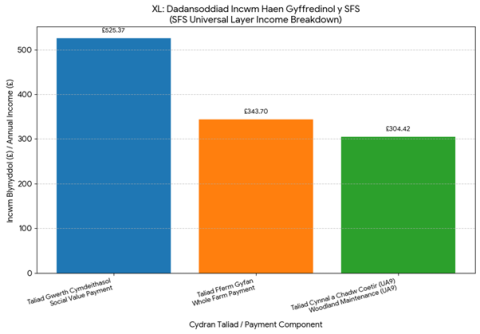
Figure 1. The breakdown of the Total Annual Universal Income (total of £1,173.49) from the Sustainable Farming Scheme's (SFS) Universal Layer for the 4.91ha Silvopasture system at Ty'n yr Onnen (in addition to the income incurred through productivity). The Social Value Payment rewards climate resilience and other Sustainable Land Management (SLM) options, the Whole Farm Payment is calculated for this area and the Woodland Maintenance Payment is for managing tree cover.
Please contact timtechnegolcff@mentera.cymru if you would like to receive a copy of the full final report for this project.