

Wallog - Final project report
Key results:
- LoRaWAN system has saved the farm approximately 30,000 - 50,000 litres of water per year by detecting major problems early, locating previously undetected slow leaks, pumping more efficiently and reducing wastage.
- Direct results of better water management have included higher animal welfare, reduced fluke risk, more efficient production and improvement of aquatic habitats for wildlife.
- Remote monitoring has significantly reduced labour time spent carrying out manual checks of the system.
- There is now sufficient data to plan stock levels and manage grazing year-round without water being a worry or significant limitation.
Background:
Wallog is an approximately 400 acres mixed-terrain farm run by Dai Evershed and his father Jack. The business focuses on nature-friendly, high-welfare production of cross-bred store lambs from around 700 Welsh ewes. In an uncertain economic landscape, their aim is to maintain or slightly increase output and standards while keeping inputs and labour to a minimum and avoiding or reducing business risks. One key priority identified is safeguarding a limited and temperamental spring-water supply, with no option to connect to mains. To reduce supply problems and cut time spent manually checking, they needed a system to monitor water availability, flow, and storage levels in real time.
Purpose of the work:
- Monitor system performance: Track water flow rates and storage volumes across the farm to detect issues early, including leaks, excessive demand, pump failures or other disruptions. This helps reduce manual checking and ensures the supply remains reliable throughout the year.
- Assess long-term water security: Build an accurate picture of year-round water availability at the spring source to understand the upper limit on stocking capacity and guide future planning.
- Improve usability and response times: Develop a mobile dashboard for clear visualisation of the entire water system and create automatic alerts for leaks, demand spikes and risks such as freezing.
What we did:
A Long Range Wide Area Network (LoRaWAN) gateway (like a router for your home Wi-Fi network) was installed at a central point on the farm to provide as much coverage as possible.
LoRaWAN flow-rate sensors were installed at several key locations:
- Inflow from the natural spring into the collection reservoir.
- Pump rate from collection reservoir to main storage reservoir.
- Gravity flow from the old farm well into the main storage reservoir (Winter only).
- Outflow from the main storage reservoir to several specific endpoints including troughs and livestock housing.
LoRaWAN water level sensors were deployed at each reservoir to monitor storage volumes, and air and soil temperature probes were installed to monitor and report supply risks relating to weather.
Devices and gateway were registered online on a platform called “The Things Network”, and an interactive mobile dashboard was created on the “Datacake” platform (other dashboard providers are available). Automated email alerts were set up on the same platform for leaks and other problems.
Pump controls were fitted with an IoT-compatible Wi–Fi smart switch for future automation.
Outcomes:
- The combination of remote monitoring through the mobile dashboard and earlier detection of issues has noticeably reduced labour demands. A realistic estimate is a saving of around five working days per year, simply by avoiding unnecessary site visits and catching problems before they escalate.
- Improved usage monitoring has also prevented substantial water loss. Previously, the system experienced around three major leak events a year, along with smaller slow leaks and periods of over-pumping. With the new setup, an estimated annual water savings of roughly 30,000–50,000 litres have been made.
- Continuous, year-round oversight - particularly during the drought conditions of summer 2025 - has given the farmers a much clearer understanding of baseline supply, confirming a minimum inflow of 5 L/min. With this information, and with more confidence in the resilience of the system, they were able to invest in a new storage tank and trough network on a large grazing block that had relied solely on a pond for stock drinking water. This single change has delivered several benefits:
- The block can now be fully incorporated into rotational and regenerative grazing plans, as animals no longer need constant access to the central pond.
- Mixed grazing and/or increasing flock size is now realistic.
- The pond has been fenced off and allowed to revert to a natural state, reducing fluke risk and improving animal health and water quality.
- Overall, the project has improved efficiency, strengthened water security, and opened new opportunities for land and livestock management.
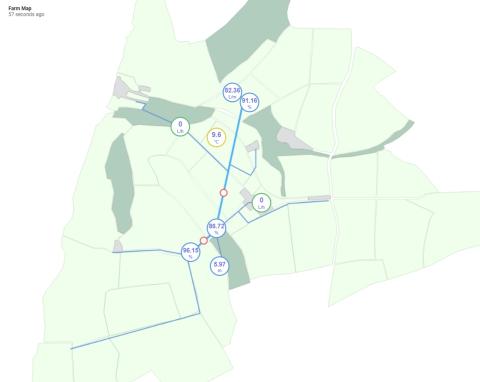
Figure 1. Screenshot of the map found in the Datacake dashboard for the Wallog water monitoring system as of 10/12/2025. Figures in white circles have been programmed to display either; well depth (m), flow rate (L/h), Water levels (% of vessel / reservoir filled) and soil temperature (℃). The blue lines represent water pipes.
How to apply on your farm:
- Check if your farm is already within range of a LoRaWAN gateway - search for “TTN coverage map” or similar. It would also be worth reaching out to your County Council, who are likely to have a team or individual with knowledge of rural connectivity technology and coverage in your area, including LoRaWAN. Bear in mind that after the initial investment, there is no ongoing cost for using LoRaWAN.
- If your farm is not in range of a public gateway, or if you want to boost coverage, you will need to install a gateway of your own. Check for grants first - for example, the Small Grants - Efficiency rounds available through RPW have often included LoRaWAN equipment including gateways and sensors.
- Once you have good coverage, install some sensors. Sensors are not limited to monitoring water, they can be used for security, electric fence status, feed store volumes, animal or vehicle tracking, weather and environmental data, and many more uses.
- Register the sensors (and gateways if applicable) on The Things Network and start collecting data.
- Add your devices to a third-party dashboard platform (an internet search of “IoT dashboard TTN” or similar should give you a list of options). There are free tiers on many of the platforms for you to try out.