

Welsh Sustainable Inputs in Action Project: Final report
Key Results
The overall effects of the biological products were variable, showing strong dependency on site conditions.
● Most consistent product: Kelp Crofters was the most consistent performer, achieving yield gains at two sites and measurable improvements in microbial activity at the third.
- Soil activity: Improvements were most clear in soil biological activity and nitrogen cycling, particularly with Sylgen, Kelp Crofters, and Sea2Soil.
- Yield: Yield responses were small overall, but Kelp Crofters consistently maintained higher dry matter yields. At Crickie Farm, Terrafed, Sylgen, and Sea2Soil produced slightly higher dry matter yields than the control.
- Feed value: Leaf tissue and feed value analyses generally showed nutrient uptake and forage quality within normal seasonal ranges, with only modest variation among treatments.
Background
Biological products are increasingly used in agriculture to enhance soil health, improve nutrient availability, and support sustainable grass growth. Previous studies have suggested that biostimulants may show stronger effects in low-fertility or stressed systems compared with high-fertility soils.
Purpose of the work
The project aimed to evaluate the effectiveness of six selected biological products on soil and grass performance across three diverse farm locations in Wales during 2025.
The specific objectives were to:
- Assess the impact of selected biological products on soil nutrient levels and overall soil health.
- Evaluate improvements in grass growth, yield, and quality under different treatments.
- Compare the performance of biological products across three distinct farm locations.
What was done
The project was conducted across three of Our Farms (Cilthrew, Cwmrisca, and Crickie) to evaluate the effectiveness of six different biological products (Table 1) and a combination treatment (of all products) against a Control (no treatment):
Table 1: The six products used during the project and their properties
Product | Properties |
Soil Point | A humic and fulvic acid-based soil conditioner, providing trace minerals and improving soil structure to support crop establishment, growth, and quality. |
Sea2Soil | A fish protein hydrolysate offering readily available amino acids and trace elements for both plant and soil health. |
Sylgen | A microbial blend of beneficial bacteria and fungi that enhances soil biology and promotes plant growth. |
Kelp Crofters | A seaweed-based product rich in auxins, cytokinins, and gibberellins, designed to stimulate growth and improve resilience to stress events |
QLF TerraFed | Filtered molasses delivering plant-available sugars to feed both plants and soil microbiology. |
BIOCAT | A novel phage-based technology targeting harmful soil bacteria, aiming to rebalance soil microbiomes and support yield and grain protein levels. |
The products were applied twice during the season at a rate of 150L/ha of water using a Tow and Fert Multi 500 sprayer. To reduce bias from external factors, the treatments were randomised within each trial site. Treatment means were estimated based on three sampling points per plot, and all resulting data analyses were performed by Lancrop Laboratories, UK.
Data collected:
- Soil sampling: Collected before the first and after the second application. Measured biological activity (e.g., soil respiration, microbial biomass), nutrient status (major/trace elements), and soil properties (e.g organic matter, pH, CEC).
- Leaf tissue sampling: Collected 2-3 weeks after each product application to assess nutrient uptake (N, P, K, Ca, Mg, S, Cu, Zn, Mn).
- Feed value analysis: Forage samples analysed after the second application for key feed quality parameters (including Crude Protein (CP), Dry Matter (DM), Metabolisable Energy (ME), and Fibre (NDF/ADF)).
- Yield measurement: Measured after the second application using a quadrant method and measured in tonnes of dry matter per hectare (tDM/ha).
Outcomes
The project showed that biological products can help maintain soil health and forage quality, but their effects were generally moderate, inconsistent, and heavily dependent on the site's environmental conditions.
Soil health and nutrient content
- At Cwmrisca, Kelp Crofters and Sylgen increased microbial biomass and respiration, indicating a short-term stimulation of microbial metabolism
- The combination treatment at Cwmrisca showed the greatest increase in calcium availability, likely due to enhanced nutrient solubilisation.
- At Cilthrew, Combination, Biocat, and QLF Terrafed increased microbial biomass and soil respiration.
Overall, changes in major soil nutrients were small, suggesting the variability primarily reflected seasonal fluctuation or sampling variability rather than clear treatment effects.
Yield and Forage Quality
Yield increases were generally small and variable, with Kelp Crofters the most consistent performer, achieving yield gains at two farms and maintaining higher dry matter yields overall.
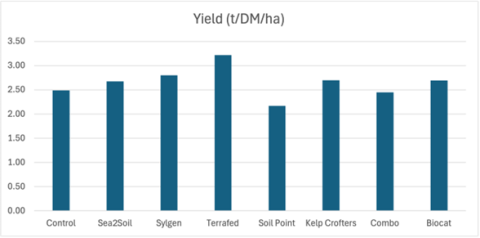
Figure 1. Dry matter yield (t DM/ha) following the second application of biological products at Crickie Farm.
- At Crickie, Terrafed recorded the highest dry matter yield (3.22t/ha), an increase of approx 0.74tDM/ha over the control (2.48t/ha) as seen in Figure 1. Sylgen and Sea2Soil also performed slightly above the control there. However, no treatment demonstrated a consistent improvement in feed value.
- Key feed parameters (Crude Protein, ME, NDF) were broadly similar across treatments and the control at Cilthrew, suggesting minimal impact on overall feed quality under the trial conditions.
- At Cwmrisca, Kelp Crofters and Soil Point enhanced crude protein and fibre content, suggesting that targeted use may selectively improve certain components of forage quality.
Although several biological products showed noticeable changes in soil indicators, leaf nutrient levels, forage quality and yield across the three farms, these findings should be interpreted carefully. A number of soil parameters, especially at Cwmrisca, displayed large numerical changes that are most likely the result of natural variation in sampling and seasonal conditions rather than a direct treatment effect. Even in cases where improvements were seen, they occurred over a single season and may not represent long-term trends. Biological inputs can support soil biology and forage quality, but their effects tend to be moderate, highly dependent on site conditions and influenced by weather, soil fertility and management practices. The results in this report should therefore be viewed as indications of possible responses rather than guaranteed outcomes.
Key things to consider depending on desired outcomes:
- Seaweed extracts such as Kelp Crofters have the potential to increase growth rates and grass yield in times of plant stress, such as low water availability. Its potential to increase photosynthetic efficiency could lead to increased Brix levels in plants, which is associated with greater pest resistance.
- Soil humates such a Soil Point have the potential to increase nutrient availability and uptake to plants and increase forage quality, especially if current soil organic matter content is below optimum levels or if soil structure is compacted or degraded. It would also be beneficial in situations where nutrient lockout is suspected due to pH imbalances or high mineral tie-up, as humic substances chelate nutrients, making them more accessible to plants and microbes. Its use is particularly advantageous during crop establishment to support root development and early vigour.
- Microbial consortium products such as Sylgen have the potential to increase forage quality and soil health in situations where soil biological activity is low, or when aiming to enhance specific ecological functions such as nutrient cycling, organic matter decomposition (including thatch breakdown), or disease suppression.
- Bacteriophage products such as Biocat have the potential to increase forage quality in systems where specific bacterial pathogens are identified as a significant constraint. It has the potential to rebalance soil microbiomes by selectively targeting harmful soil bacteria, which can support improved plant health, yield, and Protein levels
- Soil conditioners such as Sea2Soil and Terrafed may help to improve overall yield, forage quality and soil health. Their use can be particularly effective in soils with low biological activity or when transitioning from conventional to regenerative practices to kickstart microbial populations by providing readily available amino acids and trace elements, supporting rapid plant growth and recovery, and stimulating soil microbial activity, especially during periods of high nutrient demand or in biologically depleted soils .
Please contact timtechnegolcff@mentera.cymru if you would like to receive a copy of the full final report for this project.