
Awel y Grug Project Update - August 2025
What has been done?
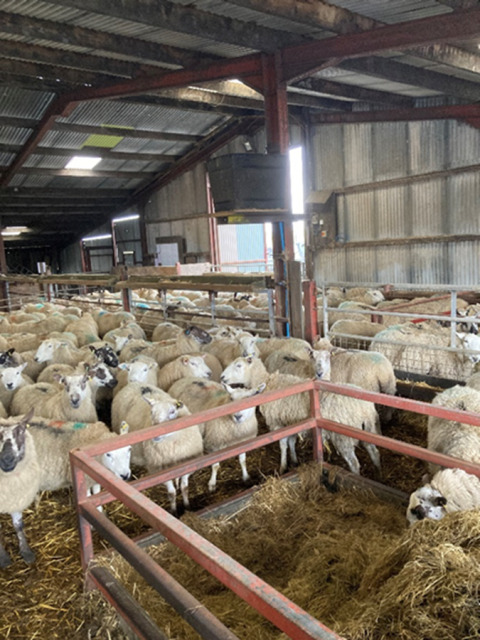
Over the final eight weeks prior to lambing in 2025, the red clover and white clover silages were fed to groups of Welsh mule and Texel cross ewes. The goal was to assess the benefits of these legume-based forages on ewe and lamb performance. Prior to and following lambing, these parameters were monitored and measured -
- ewe condition,
- lambing ease,
- lamb birth weight,
- colostrum and milk yield,
- lamb growth up to six weeks of age.
The silage produced was of excellent quality (see table 1), with an average metabolisable energy (ME) of 10.8 MJ/kgDM, which helped to reduce the need for supplements. This resulted in an estimated saving of £1.85 per twin-bearing ewe and £2.31 per single-bearing ewe on feed costs. For a flock of 500 ewes scanning at 150% this would mean a saving of £1040 in feed costs alone. Labour savings were also made on daily feeding of single bearing ewes and twin bearing ewes several weeks from lambing.
Table 1: Silage analysis 2024
*wet chemistry
Lamb birth weights were generally good. Lambs from ewes on red clover silage tended to be slightly heavier twins, while those from mature ewes on white clover silage were slightly heavier singles (this could partly be attributed to the fact that the red clover singles group consisting of more yearlings than the white clover single group). The fastest-growing single lambs were born to mature ewes fed white clover silage, showing daily live-weight gains of over 300g. In contrast, twin lambs born to ewes fed red clover silage grew faster than those on white clover silage.
Next steps
For phase 2 of the project we will compare the weight gain of lambs grazing the Red Clover based ley, the White Clover based ley and a permanent pasture.
- Lambs will be randomly allocated to 3 even groups according to current weight, sex, breed and whether born a twin or single.
- Each group will be rotationally grazed on their allocated plots using temporary electric fences to ensure minimum ‘on time’ and adequate rest periods.
- Lambs will be weighed every 3 weeks until they reach the target weight and condition and are sent to market or slaughter. Data gathered will be analysed and combined with the phase 1 data to produce the final report, including a return on investment for both seed mixtures trialled.
For a full interim project report, please contact timtechnegolcff@mentera.cymru