

Castell Crugiau Final Update
Key results:
- Willow fed lambs showed a much higher blood level of vitamin B12 than the untreated group
- Increased copper and selenium levels were noted in both groups compared to the beginning of the trial, although the willow-fed group showed greater increases
- The use of willow would seem to be a useful management tool provided an efficient and easy way to feed it can be found.
Background:
Marc and the family have been exploring if willow can naturally supplement cobalt for lambs, replacing costly boluses and drenches. They have observed that lambs readily eat willow, and it grows well on the farm. Lambs on pasture often don't get enough cobalt, especially in summer, which can affect their growth. With the advice and consultancy of Angus Wyse of Castle House Vets, this trial compared lamb health and growth on a multispecies ley with and without the addition of willow for browsing. Parasite load and blood mineral levels were monitored to evaluate the offer of willow. Ultimately, the purpose of the trial was to investigate a low-cost, sustainable way to improve the flock's health and performance.
Purpose of the work:
- Feeding willow to lambs: what effect does it have on growth rates and blood minerals
- Harnessing tree forage nutrients: will harvesting willow offer a sustainable and low cost solution
What we did:
- A group of 32 male store lambs with similar variation in weight were split into 2 groups of 16
- All lambs weighed and blood sampled on 4 August with additional group FEC samples taken and they were treated with a broad spectrum anthelmintic
- One group of 16 lambs grazed multispecies ley
- The second group of 16 lambs grazed multispecies ley plus additional harvested willow fed through a feed barrier, replenished every few days
- Lambs were weighed 6 weeks later (differentiated with EID tags), and blood tests and FEC of the 2 treatment groups was carried out on 2 October.
Outcomes:
Mineral and vitamin levels
- Cobalt and vitamin B12: At the start of the trial, blood testing showed that 10% of the lambs were cobalt deficient. By the end of the trial, no such deficiency was noted in any of the lambs. The willow-fed group however showed significantly higher levels of Vitamin B12 compared to the untreated group, suggesting that willow supplementation effectively improves cobalt status.
- Copper and selenium: Both the willow-fed and untreated groups showed increased levels of copper and selenium by the end of the trial. The willow-fed group had a more significant increase in both minerals. In addition, copper levels which were already slightly elevated at the start of the trial also remained so throughout. This raises a potential concern for copper toxicity if lambs are given supplements containing copper or fed a high-concentrate diet in the future.
Growth rates
Overall, lamb growth rates were lower than anticipated, a consequence of a very dry summer with poor grass growth. However, the lambs in the willow-fed group gained an average of one kilogram more than the untreated group over the six-week period.
Conclusion
The results suggest that feeding willow to lambs is a beneficial management practice that can significantly improve cobalt status and have a positive effect on copper and selenium levels. The benefits of a willow-supplemented diet might be even more pronounced if the animals' primary diet is not a herbal ley as herbal ley tends to have a higher content of trace elements compared to traditional grass-clover mixes. The diverse species in a herbal ley, such as forbs like chicory and plantain, and legumes, are naturally higher in many of these key elements, which can improve livestock health and performance. While the trial showed a positive effect on growth, further investigation into a practical and efficient method for feeding willow to lambs is needed.
How to apply on your farm:
- Do you believe you have a trace element deficiency? Take a pooled FEC sample to minimise the impact of worms on lamb performance.
- Collect blood samples from each lamb (or percentage) for initial analysis to find a baseline
- Determine how you can feed the willow: cut and provide fresh willow branches, a simple feed barrier can be used to prevent trampling and waste. Replenish the willow every few days to ensure constant access. You could also allow free browsing of the trees in a paddock.
- If you wish to determine the impact of willow on your own lamb performance, you should weigh the lambs before introducing willow and again before selling or when at optimum weight as ewe lambs.

Photo 1. Lambs stripped the willow leaves easily through feed barriers.
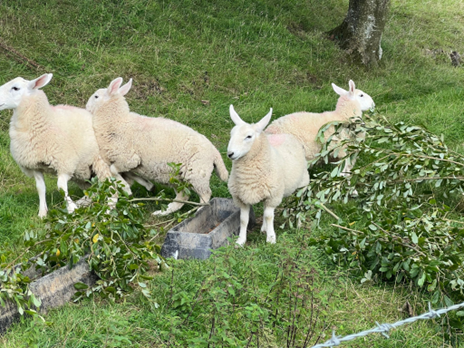
Photo 2. Willow offered on the ground.