

Comparing lamb performance on different leys - Final Report
Key Results
- Lambs on the multispecies ley gained 1.2kg per lamb more than the high sugar grass ley over the 25-day monitoring period.
- A reduced worm burden was observed in lambs grazing on the herbal ley compared to those on the high sugar grass ley.
Purpose of the work
The primary purpose of this project was to compare the performance of lambs on different ley types, already established on farm in the previous year, to identify the most effective composition for maximising post-weaning lamb performance.
What we did
Multispecies and high sugar grass leys were established on fields that had been managed similarly in the past. The seed mixtures established were as listed in Table 1:
Table 1: Species content list of multi species ley and high sugar grass ley
Multi species ley | Aber high sugar grass ley (HS4) |
AberGreen - Perennial ryegrass (3kg) AberZeus - Perennial ryegrass (3kg) AberClyde - Perennial ryegrass (3kg) Comer - Timothy (1kg) Agric Tonic - Plantain (0.75kg) AberClaret - Red clover (1.5kg) Endure - Chicory (0.25kg) Puna II - Chicory (0.25kg) Liflex - White clover (0.15kg) AberDai - White clover (0.2kg) AberAce - White clover (0.05kg) AberLasting - White clover (0.15kg) AberPearl - White clover (0.1kg) AberSwan - White clover (0.35kg) | AberWolf - Intermediate Perennial Ryegrass (3kg) AberZeus Intermediate Perennial Ryegrass (4kg) AberClyde Intermediate Perennial Ryegrass (2kg) AberLee Late Perennial Ryegrass (1.5kg) AberGain Late Perennial Ryegrass (3.5kg) |
Silage was cut from both leys, with the multispecies ley yielding 9.7 bales/acre (1st cut) and 5.1 bales/acre (2nd cut), and the high sugar grass ley yielding 9 bales/acre and 4.9 bales/acre, respectively.
Following an abnormally wet summer, weaned Speckle ewe lambs were introduced to the leys from 1 October to 25 October to collect performance data. During this period, lamb weights and worm burdens were monitored.
Outcomes
The project demonstrated that the multispecies ley provided better overall lamb performance. The higher daily liveweight gain as highlighted in figure 1 and the added benefit of a reduced worm burden on the lambs show the effectiveness of this ley composition. The lambs on the multi species leys gained on average a total of 1.2kg more per lamb than the lambs on the high sugar grass leys during the monitoring period.
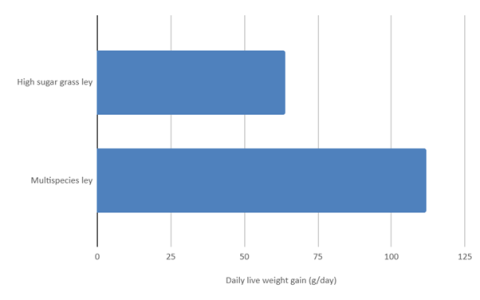
Figure 1: Multispecies and high sugar grass ley effect on lambs DLWG
Multispecies leys drives performance through health and nutrient synergy. Other studies have also shown that the inclusion of herbs like chicory and plantain delivers two key benefits:
- Reduce worm burdens: Studies have shown that the bioactive compounds (condensed tannins) found in herbs can reduce faecal egg counts by up to 78% in spring lambs.
- Micronutrient availability: Deep-rooting herbs mine for essential minerals (e.g cobalt and selenium).
Treforgan has integrated more multispecies leys into its rotation, recognising they are a valuable part of a diverse system of several ley compositions:
- Multispecies leys require long rest periods, particularly over winter, to maintain species diversity and avoid crown damage.
- High sugar grass leys are high output, offering the potential for high-quality silage and more intensive grazing.
- Permanent pastures offer reliable, resilient grazing, especially during challenging months.
They will also continue to monitor performance of lambs as these leys may perform differently as the sward composition changes in the herbal leys over time. As the herbs' persistence depletes, the sward eventually sees a "grass takeover". This compositional shift impacts forage quality and yield, and return on investment must be considered in this respect.
How to apply on farm
- Consider the benefits of establishing various ley compositions, including grasses, herbs and legumes - each has a role within the system.
- Ensure multispecies leys are grazed carefully to avoid damage - they do require long rest periods, especially over winter months.
- Multispecies leys have key benefits in reducing worm burdens and for micronutrient availability so should be considered as a suitable ley for lamb finishing.
- High sugar grasses also have a role within the system, especially for producing high quality forage for winter. There is an e-learning module available on the benefits of high sugar grasses, log in to BOSS to learn more.