

Manor Avon Farm: Our Farms Project Final Update
Integrating Sustainable Land Management for enhanced dairy farm profitability and regulatory compliance
⮚ Key results:
This project dismisses the need to choose between a productive dairy farm and a healthy river. It identified three ways to save money, alleviate problematic issues and make the farm resilient for the future by working with nature and using simple, effective technology.
- Utilising a slurry separator to reduce slurry storage requirements by 20%, therefore immediately achieving full regulatory compliance whilst avoiding major capital expenditure - a cost-effective route to meeting the five-month storage mandate.
- Optimising the use of slurry to reduce purchased fertiliser costs: the separator splits the slurry into 1) stackable solids (like farmyard manure) and 2) easy-to-pump liquid; turning slurry into a top-quality, manageable fertiliser. The consistent output quality drives greater operational efficiency, resulting in lower fuel, labour, and time expenditure during fieldwork.
Implementation of Natural Flood Management (NFM) techniques, including bioengineering and floodplain reconnection to effectively mitigate the risk of land loss due to high-velocity flood erosion, thereby securing the land's capital value and avoiding recurrent high-value repair costs.
⮚ Background:
Manor Avon is a 500-acre dairy farm near Llandeilo, maintaining a 340-cow milking herd and relying on grass and silage production from its fertile alluvial flood plain. The farm’s boundary lies along the meandering River Towy, a scenically and ecologically valuable lowland river. However, increasing flash flooding, driven by climate change, now poses a severe threat, causing substantial river bank erosion and the loss of vital agricultural land. This project addresses the critical challenge of protecting the farm’s environmental and land capital. The core aim is to identify and implement appropriate and effective riparian management methodologies that alleviate bank erosion, utilise natural processes, and enhance the river’s ecological habitats for long-term dairy farm sustainability.
⮚ Purpose of the work:
This project is a comprehensive study testing how to make an intensive dairy farm on the vulnerable River Tywi floodplain both economically viable and environmentally sustainable. It provides modelled examples for implementing Nature-Based Solutions and Sustainable Land Management (SLM). The primary aim is to mitigate challenges like riverbank erosion and water pollution while securing the farm's financial resilience.
The work focuses on three main, interconnected goals
Protect and restore the environment: Implement riparian management and green engineering to safeguard the River Tywi by alleviating erosion and reducing diffuse pollution.
Secure and enhance the farm’s resilience: Future-proof the dairy operation against environmental threats and regulatory compliance (e.g., using a slurry separator and controlled rotational grazing) to improve soil health and farm finances.
● Demonstrate innovation and deliver multiple benefits: Demonstrate how running a dairy farming business in a vulnerable area can be productive and provide environmental benefits, aligning with Welsh SLM outcomes for wider societal benefit.⮚ What we did:
The project was an investigative and advisory study on an intensively-managed dairy farm on the River Tywi floodplain - a Special Area of Conservation (SAC). The study focused on developing Sustainable Land Management (SLM) and Nature-Based Solutions (NBS) to tackle challenges between dairy operations and environmental protection.
Key actions included:
Baseline Assessment: Collecting data by undertaking riverbank surveys, soil health analysis (Visual Evaluation of Soil Structure VESS scores), and a full infrastructure review against The Water Resources (Control of Agricultural Pollution) Regulations in Wales
Analysis: Assessment of widespread soil compaction, riverbank erosion, and nutrient pollution risks.
Strategic Recommendations: Proposing soft engineering for riverbank stabilisation, a shift to managed rotational grazing to improve soil health, and recommending a slurry separator to achieve mandatory storage capacity and regulatory compliance.
⮚ Outcomes:
This study proves that proactive stewardship is key in delivering economic productivity hand-in-hand with delivering for the environment, and transforming ecological challenges into resilient business opportunities.
A grant-aided slurry separator will achieve compliance with the Water Resources (Control of Agricultural Pollution) (Wales) Regulations by reducing liquid volume by 20%, negating the need for a large financial investment in a new storage facility. The resulting precision nutrient management significantly reduces annual artificial fertiliser costs.
Environmental & Ecological Outcomes: The project highlighted a need for ecological improvements, i.e. enhanced river corridor resilience through bioengineering techniques (like willow spiling) and establishing riparian buffers, which prevent the costly loss of productive land capital. These buffers can significantly improve water quality by filtering diffuse pollution and creating new vital wetland habitats for species like the European Otter, leading to biodiversity net gain. Furthermore, a shift to managed rotational grazing combined with mechanical aeration shatters hardpan, successfully restoring widespread soil health and increasing water storage capacity.
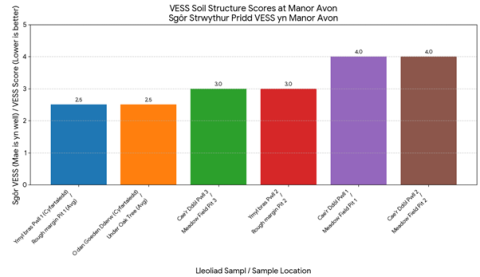
Figure 1. Visual evaluation of soil structure (VESS) scores for various sampled locations.