

Moor Farm Pre Mowing trial results
Key Results
- Pre mowing grass does not improve grass quality- Metabolisable Energy(ME), D-Value, Crude Protein (Table 2)
- There is no economic benefit to pre mowing grass in a rotational grazing system other than it “looks nice” but it can allow flexibility in management (Table 4)
- It can be used as a tool to manage high covers (>3,400 kgDM/ha) and improve utilisation in the grass wedge when you cannot afford to take paddock out as surplus – can be used effectively in a drought situation
- Pre mowing grass did not encourage more grass growth- in our trial, grass that was pre mowed grew 0.4 tonne DM/ha less than the control (Table 2)
- Pre mowing grass did not reduce weed burden in the paddocks
Background
Moor Farm utilises a rotational grazing system for its spring-calving Holstein Friesian herd during summer, supplemented by on-off grazing in spring and autumn to maximize grass intake. This herd comprises medium-sized cows with higher production and intakes than typical NZ-based cross-bred spring calvers.
This project investigates the effectiveness of pre-mowing to maintain pasture quality. Previously, the farmer pre-mowed paddocks with covers exceeding 3,100kg DM/ha or when grass was stemmy/reproductive, sometimes doing this 3-4 times per season. The farmer currently believes pre-mowing is a cost-effective strategy to maintain pasture quality, reduce weeds, and optimise both herd performance and pasture intake.
Purpose of the work
Limited research exists investigating pre mowing in a medium output grass based dairy system, so a trial was set up to investigate the effects of pre mowing on:
- Pasture quality during the grazing season
- Weed burden in paddocks
- Grass growth
- Animal intakes, production and animal behaviour (lying and eating times)
- Cost effectiveness
What we did
- A field beside the yard was chosen for the trial, and this was split into two 1-hectare paddocks:
- Paddock A was the control method of grazing standing pasture with no machinery intervention during the summer monthsb.
- Paddock B was pre mowed around 6-12 hours before every round during the grazing season
- Grass growth was measured weekly or fortnightly using a plate meter and also by the cut and weigh system to determine tonnage dry matter per hectare
- Fresh grass samples were taken before grazing each paddock and for NIRS analysis
- A quadrat was used to assess visual pasture quality, weeds present, pasture density before, during and at the end of the trial
- Rumination cow collars were installed on a random 10 cows in the herd and cow behaviour was monitored including rumination, intakes, time grazing and lying times
Outcomes
Table 1. Tonnage grown per ha on each paddock in 2025
Paddock | Area | Total Tonne/ Ha | Tonne/Ha Jan-Apr | Tonne/Ha May-Aug | Measurements | Daily Average |
Control | 0.856 | 6.4 | 1.5 | 4.9 | 14 | 46.8 |
Pre mowing | 0.856 | 6 | 1.6 | 4.4 | 14 | 39.7 |
Table 2. Grass analysis
Control Treatment | |||||||
Date |
| 3/5/25 | 18/5/25 | 5/6/25 | 29/6/25 | 15/7/25 | 31/7/25 |
Dry Matter | (g/kg) | 198 | 215 | 176 | 193 | 197 | 189 |
ME | (MJ/kg) | 11.3 | 10.9 | 11 | 10.9 | 11 | 11.2 |
Crude Protein | (g/kg) | 185 | 184 | 191 | 210 | 169 | 184 |
D-Value |
| 72 | 69.2 | 70 | 69.4 | 69.7 | 71.2 |
Pre Mowing treatment | |||||||
Date | (g/kg) | 9/5/25 |
| 2/6/25 | 28/6/25 | 11/7/25 |
|
Dry Matter | (MJ/kg) | 196 |
| 216 | 208 | 210 |
|
ME | (g/kg) | 11.2 |
| 10.8 | 11 | 10.8 |
|
Crude Protein |
| 172 |
| 161 | 204 | 176 |
|
D-Value |
| 71.2 |
| 68.5 | 69.9 | 68.6 |
|
*In this trial grass samples were gathered prior to pre mowing/grazing; in dry conditions grass dry matter of the feed available to the cows on pre mown paddocks would be different to the above results
The data gathered from the cow collars (Figure 1) did not show any noticeable difference in cow behaviour on the pre-mowed paddock to any other paddocks grazed on the farm.
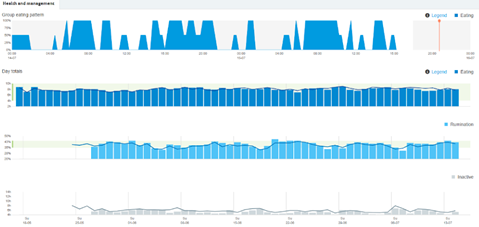
Figure 1. Rumination cow collar data
Weeds and pasture visual quality: A quadrat was used for weed count and visual pasture quality assessment during the trial, but we saw no significant difference between treatments over the trial period. Weeds were not sprayed during the trial period.
Other options for managing paddocks:
- Topping - Regrowth can be affected if topping doesn’t take place immediately after grazing, it would represent a similar cost to pre mowing.
- Baling - If grass is plentiful elsewhere on the farm, then mowing and baling grazing paddocks that have longer grass is the most suitable option to maximise utilisation.
- Shifting cows more often - For reduced fuel and machinery costs compared with pre-grazing mowing etc, shifting the herd 2 / 3 times within a 12-hour period can lead to better utilisation of higher covers.
Table 3. Grass demand per cow for production
| Cow Live weights kgs | |||||
Kg MS/Cow/Day | 350 | 400 | 450 | 500 | 550 | 600 |
1 | 12.3 | 12.9 | 13.6 | 14.2 | 14.8 | 15.4 |
1.25 | 13.8 | 14.5 | 15.1 | 15.7 | 16.3 | 16.9 |
1.5 | 15.3 | 15 | 16.6 | 17.2 | 17.8 | 18.4 |
1.75 | 16.9 | 17.5 | 18.2 | 18.8 | 19.4 | 20 |
2 | 18.4 | 19.1 | 19.7 | 20.3 | 20.9 | 21.5 |
2.25 |
|
| 21.2 | 21.8 | 22.5 | 23 |
2.5 |
|
|
|
|
| 24.6 |
Dmand for cows based on feed @1212MJME/kgDM. 85% utilisation of feed (Agrinet, 2025)
*Kg MS/Cow/Day = Kilograms Milk Solids per Cow per Day
Table 4. Cost of mowing 1 hectare in 1 hour
Labour | £20-30 |
Machinery Depreciation | £15-25 |
Fuel | £10-20 |
Wear and Tear | £5-10 |
Total | £50-90 |
*Above are estimates: The cost would vary greatly depending on whether it is a farmer or contractor operator plus the machinery and tractor employed in terms of depreciation and fuel usage.
Conclusions
- This work has indicated that there are few gains to be made through pre-graze mowing of paddocks. However, if this method is to be used then it is important to consider timings of the mowing and subsequent grazing.
- Future add ons to the project: there may be longer term effects on weed presence, plus soil organic matter, nitrogen levels and microbial biomass, as well as biodiversity and carbon sequestration that would require further investigations.