

21 August 2025
LED lighting has been linked to an increase of 6.1% in layer production at a Powys free-range egg farm, an uplift worth £27,192 a year in the 16,000-bird business.
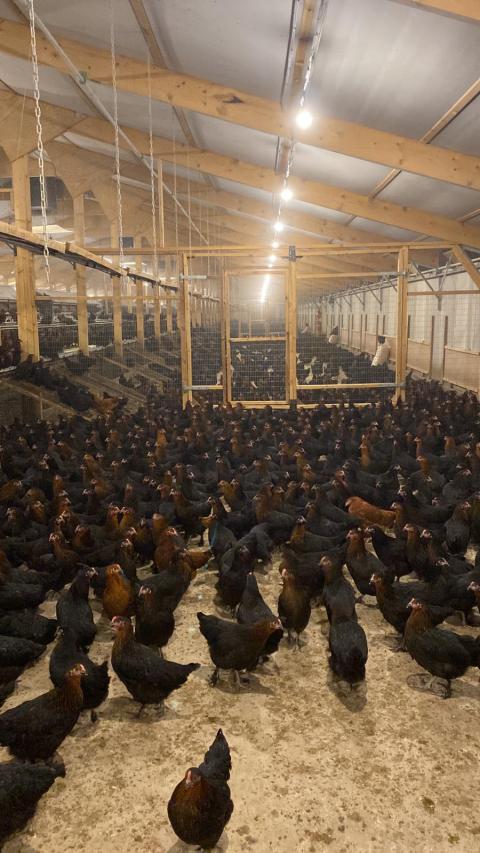
Third generation farmer George Wozencraft produces eggs from a flock of Burford Brown hens at Glanalders, Nantmel, to supply Stonegate under its Clarence Court brand.
As part of his project work as a Farming Connect Our Farms programme, the influence of lighting on flock performance has been investigated.
George replaced 54 x 2ft strip lights with three lines of 48V/9.6W warm white LED lights, 105 lights in total, when he depopulated a flock from the shed in March 2024.
A new flock of 16-week-old hens was introduced to the shed the following month.
During the first eight weeks of their laying cycle, the lighting was on for 10 hours in every 24, increasing to 14.5 for the remainer of the 78-week cycle.
Software analysis of the performance data of that flock and the preceding cycle showed significant gains from the modern lighting.
- Birds came into lay sooner and egg production increased by 6.1%, worth £27,192 in that cycle
- Energy costs over 78 weeks reduced by £2,724.08
- An annual carbon saving of 1,218 kg CO₂e was achieved
Energy costs and gains were calculated from a capital cost of £9,200 for the lighting, 30.85p per kWh of electricity and a grid emission factor of 0.20705 kg CO₂e/kWh.
Energy savings alone would cover the cost of the lighting within 5.1 years, says Dr Delana Davies, the Farming Connect Sector Officer who oversaw the project at Glanalders.
Compared to fluorescent lights, LED lights are more energy efficient, and is why the farm cut £2,724.08 from its electricity costs.
LED lights need less frequent replacement than conventional bulbs too, further adding to cost savings.
Although George had previously installed 20kW solar panels on his poultry housing roof that energy only met around a third of the shed’s annual requirement.
Delana says a reason for LED’s contribution to improved flock performance is poultry’s greater sensitivity to colours and vision on the ultraviolet spectrum.
“The presence of different colours, intensity and periods of light can all have an influence on layer behaviour and performance,’’ she explains.
“LED lighting has a better spread than conventional lighting, eliminating dark spots and reducing stress, and therefore has the potential to improve stimulation of the birds’ natural day and night behaviour and improve performance.’’
Critically, for bird welfare, they are generally flicker-free, Delana adds.
“The ability to customise the light spectrum is another significant advantage of LEDs over older lighting technologies, which often have fixed and less optimal spectral outputs for poultry.’’
She does point out that other factors, aside from lighting, could have contributed to the production gains too.
“Optimising rearing success and ambient temperature have an influence, and also season and day length, although length of day for the flock is controlled by a prescribed lighting plan in the early stages to bring them into lay.’’
The health, appearance and mortality rates in the two crops of birds involved in the project was assessed and were found to be similar.
George had anticipated positive results from introducing new lighting but the energy savings and uplift in egg production exceeded his expectations.
“I knew there would be a good energy saving from replacing the old-fashioned strip lights with LEDs but the actual savings have been massive,’’ he says.
“The increase in egg production can’t be put down entirely to the lights but they will have had a big influence.’’
The cost savings and additional income generated will help boost business profitability, George adds.
“Anything that can help us increase profit is not only good for our business but it means more money going into the local economy.’’