

10 February 2026
Maternal gains achieved through performance recording are enabling a Welsh college farm to lamb its multiple-bearing ewes outdoors on land ranging from 1000 - 1300 feet.
College Cambria Llysfasi near Ruthin grazes its 120-head flock of pure Welsh Mountain ewes on mountain land.
With winter conditions at times harsh, those sheep need traits that allow them to survive and thrive in that hill environment.
Performance recording has provided a new and valuable pathway to enhancing key traits that enable that.
In 2023, the college successfully applied to join the Farming Connect Welsh Sheep Genetics Programme (WSGP) to genetically improve the flock.
Estimated Breeding Values (EBVs) have since been used to target selected traits, including maternal ability and lamb growth rates.
Although performance recording is a long-term strategy which therefore means the cumulative gains can take a while to be seen, just three years into the programme and Llysfasi is seeing those improvements.
Historically, ewes carrying triplets were lambed indoors, adding cost and labour to the system, but maternal ability has improved to a level that shepherd Alun Jones has the confidence to lamb these on the mountain.
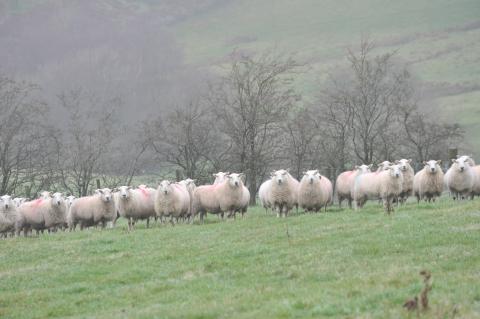
“The ewes are holding their body condition better, we haven’t had any problems with lambing them outdoors and they keep their lambs very well,’’ says Alun.
That is true of the entire flock of Welsh Mountains, he adds. “We are getting fewer losses, no mismothering, and there is less intervention needed – in the 2025 lambing season we only needed to assist two ewes out of 120.’’
Llysfasi runs 600 ewes in total with a further 120 Welsh Mountains crossed with Abertex to produce a mule ewe lamb, and 380 mules crossed with a Beltex or Texel ram.
A decision had been made to phase out the Welsh Mountains a few years ago and numbers were reduced to 80 but the value of that breed to the system prompted a rethink and a rebuilding of numbers.
This was in part a reason for joining the WSGP, says Llysfasi’s farm manager Dewi Jones.
“As we were rebuilding the flock we wanted to gain better ewes so joining a group of farmers who benchmark and record was a good opportunity.’’
Until 2023 Welsh Mountain type breed was a hardy North Wales, but breeding shifted to Llandovery Whiteface and Talybont Welsh, sheep with a bigger frame that can produce higher value lambs within the same environment.
Performance recording started in October 2023 and involved the 120 youngest Welsh Mountain ewes.
Tissue samples were taken along with body condition score (BCS) and weights.
“At that stage we were creating a baseline of data, until then we had only been doing it subjectively by taking weights but in terms of data overall, we weren’t getting the rigour, the hard evidence,’’ says Alun.
Estimated Breeding Values (EBVs) are now used to improve selected traits, including maternal ability, muscle depth, weights, and lamb growth rates.
The Welsh Mountains, which are only supplemented with mineral blocks, lamb from the second week in April.
Lambs are creep-fed for finishing, and although these are currently sold from November to January the ambition is to bring this forward by a couple of months and without concentrates.
Lambs are sold at both Ruthin livestock market and to ABP, with liveweights averaging between 38 and 42kg and deadweight between 17 and 18kg.
While Dewi accepts that breeding for desired traits in the Welsh Mountains will be a slow process, he says improvements in maternal ability are now evident.
“Because we also use the Welsh Mountain ewe for crossing, some of the growth and muscle depth characteristics will come a little bit further down the line, from the sire side.
“Improvements are not necessarily linear because the sire has quite a bit of an influence, for example our eight-week weight average is 28.1kg which puts us in the top 25% for the breed but on the EBV index we are in the top 5%.’’
Among the advantages of performance recording is the opportunity to remove the bottom performers, he adds.
“When we started recording, we could see that some of our ewes were already performing really well, we were surprised just how well, but all of a sudden we were in a position of knowing which ewes weren’t performing on EBVs so that we didn’t breed from them, removing this element of less desirable traits by selective breeding.’’
By removing the bottom 20%, the index overall for the purebred hill flock has improved from £13 to £16.24.
Dewi expects the improvements to filter down to the wider flock.
“We need to make sure that we get the Welsh ewe right first, we have selected our best ewes for the purebreds, and we will produce crossbred ewes from some of the others but eventually, when the number of the Welsh purebreds increases, we will have more choice of ewe for the production of the crossbred ewe also.’’
Having the flock’s breeding values helped inform the choice of a ram at the Prohill sale in 2025.
“This is where the magic happens, having the hill index and the individual index when you are at a sale, it meant we were able to have our red lines on rams that we wouldn’t buy because of the data not being good enough,’’ Dewi explains.
“However, type is important too, we do need that good solid type as well as figures, that is an important criteria.
“Some breeders would say that the data is a bonus but you do need both, data is power to your argument for selection, it helps you with selection because once you know what your ewes are like it is a good motivator not to buy a ram that is going to pull them in the wrong direction.’’
It is evident from Llysfasi’s data that the indexes of some of its own ram lambs are like the rams at that Prohill sale.
Dewi sees opportunities in this going forward.
“Now we know which ram lambs have those indexes, while being mindful of inbreeding we could use some of own stock for breeding or potentially sell them, animals that would have gone for slaughter before we started recording.’’
Llysfasi also has a dairy herd and Dewi has seen the benefits recording has delivered for the herd and the dairying sector in general.
Going forward, he hopes sheep producers will recognise the potential EBVs hold for them too.
“The sheep industry isn’t as data driven as dairy so in some ways, we are putting a lot of effort to recording and collecting data, but that data is not widely utilised or understood.
“The commercial rewards are there for having that data but with the back-up of type, it is about achieving a balance.’’
The WSGP has been an excellent introduction to performance recording, he adds, and he sees few downsides from recording - time and effort as well as cost the biggest constraints.
“There is an enormous amount of data that we generate with the cows and yes, we pay other people to support us with that data collection but by and large it is done automatically as the cows go through the parlour.
“With sheep, the process is very manual, however if we don’t do it, how do we improve, and how will we know if we have improved?’’